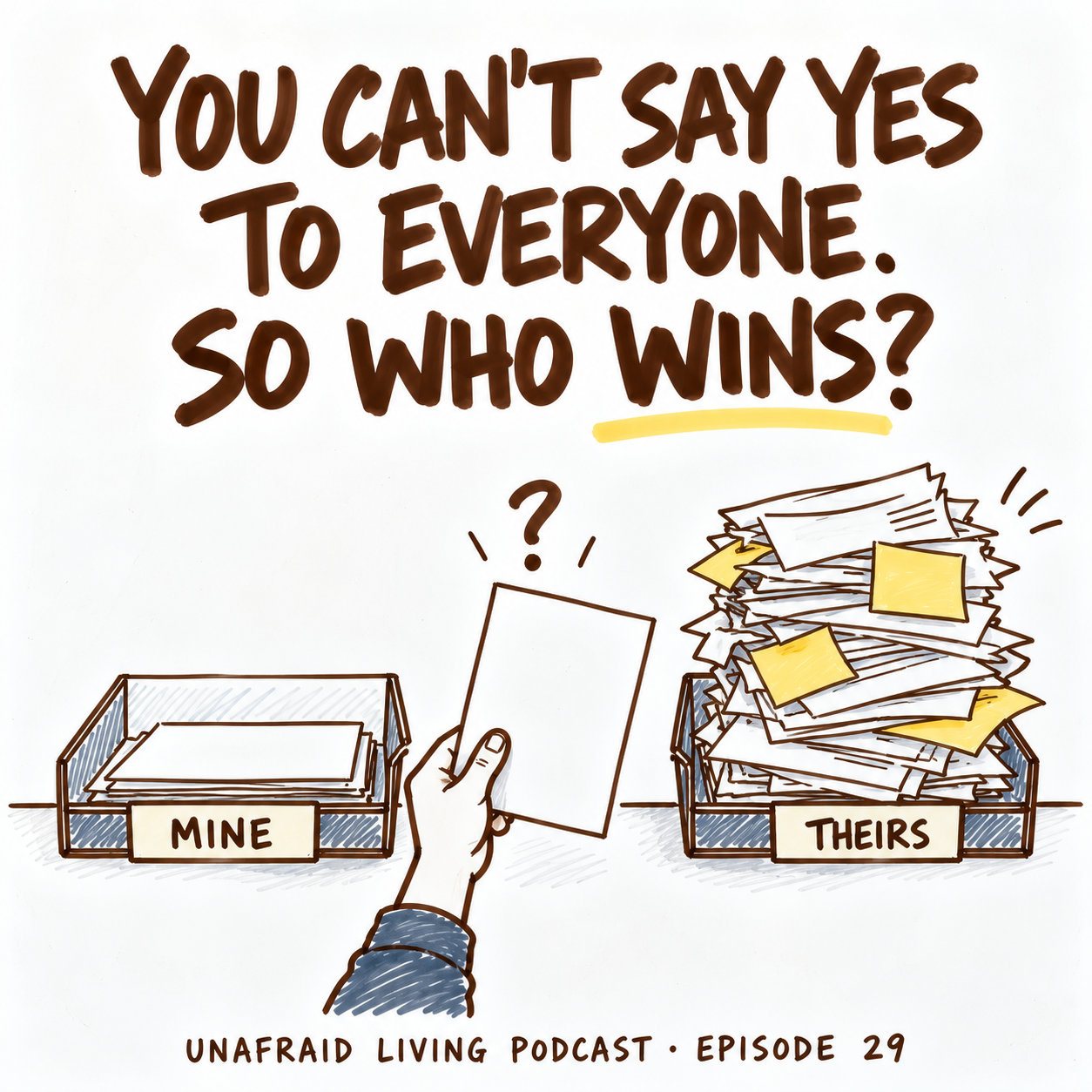
You have your day planned. There are things you need to do, things you've promised other people, and maybe even something you've been looking forward to.
Then someone asks for a favor.
It's not an emergency. You know that. But they're counting on you, and you can hear the disappointment in their voice when you hesitate. Suddenly, everything else on your calendar feels less important.
How did their request become your top priority in less than thirty seconds?
That's where discernment comes in.
Discernment is seeing clearly, then deciding wisely — weighing what's important instead of automatically responding to the loudest need.
In Episode 29 of the Unafraid Living podcast, Kim and I talked about discernment. It's the last episode in our Harmonizer Series, and if you took the quiz and came out a Harmonizer, I think this is the one that pulls the whole series together.
For people pleasers, the hard part is usually the weighing, because the loudest need in the room tends to feel like the most important one. Discernment means stepping back, looking at everything that's true, including your own responsibilities and values, and then choosing which need gets the most weight this time.
What Makes Discernment So Important?
The way we define it is simple: seeing clearly, then deciding wisely.
Earlier in the series we talked about honesty, which helps you recognize what's true and see the information clearly, and self-awareness, which helps you notice what's happening inside you. We also talked about respect — it helps you recognize that other people's needs and feelings matter without always making them your responsibility.
Discernment is the next step. Once you have all that information, discernment helps you decide what to do with it and how much weight each piece deserves.
Harmonizers are so tuned in to other people. They notice facial expressions, tone of voice, who's disappointed and where the tension is in a room. That's a gift, and we don't want to take it away from anyone. The struggle is that they gather a lot of information all the time, and it can be hard to know which thing to care about first.
Why Does Everything Feel So Urgent?
Your brain is built to notice what stands out. Researchers sometimes call this salience: the brain's way of flagging something as worth your attention right now. Things that are loud, repeated, emotional or close by tend to win that contest. That's useful most of the time. It's how you notice the smoke before you notice the dishes.
For a people-pleaser, other people’s needs feel loud to you, so they feel more urgent than they really are. Someone else's disappointment is very loud. Five missed calls are loud. A friend's sigh across the table is loud. And when something is loud, it can start to feel important, even urgent, before you've had a chance to think about it.
Loud and important are two different measurements, though. The loudest signal might be the one that matters most, and sometimes it is. But sometimes it's just the one that's ringing. That's why so much of discernment comes down to stepping back from the loudest signal and looking at the bigger picture. You notice everything that's true, including the quieter things, like your own capacity and what you've already promised other people before you decide.
What Is Your Brain Doing When You Fix Someone Else's Discomfort?
Here's a pattern I see a lot. Someone near you is uncomfortable, and because you're so tuned in to them, their discomfort starts to feel like yours. So you do something. You say yes, you smooth it over, you fix it. Their discomfort goes down, and so does yours.
Your brain learns from that relief: "Huh, that worked. Let's do it again." Relief is a powerful teacher, and when a response reliably takes the tension out of a room, your brain is likely to reach for it faster the next time. Do that over and over and it can start to feel automatic, until one day you realize it isn't sustainable.
The catch is that what works for the next ten minutes might not work tomorrow. It might not be good for the relationship. It might crowd out other commitments. I go through spells where double booking is a real problem for me, because I say yes to too much and don't always write it down. I've had to get very diligent about my calendar.
When we keep overextending, we can end up exhausted, mentally and physically, and sometimes carrying a load of false guilt.
Is Their Disappointment Your Job to Fix?
This is the line from the episode I'd most like you to remember: we gather the information, but the information isn't instruction. Your instruction comes from discernment. Their feelings are information worth noticing. My feelings are also information. Neither one should automatically win.
Someone being disappointed doesn't necessarily mean I did something wrong, or that I need to fix it, or that I should change my answer. Now, if I said something harshly, I might want to soften it. But I'd soften it because I don't want to speak to someone that way, which is a very different reason from softening it so they'll feel better about my ‘no’.
Feeling uncomfortable doesn't automatically mean I should say yes or no. It's a reason to step back and look. But here's something to watch for: When we realize we're people-pleasers, we may swing to the other extreme, saying no to everything. That doesn't feel very good to a harmonizer but it may seem like it is what you're supposed to do. It isn't. Discernment keeps you out of both ditches.
Is This Mine To Carry?
I have a backpack I love for traveling. It starts out small, but it has all these little pockets that keep expanding, and a lot of us want to be like that backpack. Somebody has a need, and I feel responsible for meeting it. Someone's upset, and I feel like I should help them be okay. But I can help doesn't necessarily mean I should help. Even the backpack has limits. And the truth is, some things should be packed in the suitcase.
Sometimes there may be someone better suited to the job, or it may be that the most loving thing to do is to step back and let people solve their own problems. Of course, inconvenient doesn't necessarily mean it isn't mine to carry. Sometimes my discerning brain says, "Yes, this is hard, and it is heavy, so let's carry it — together, because I love you." Love really does cost something sometimes. Responsibility sometimes overrides preference, and love sometimes overrides preference.
Five Questions To Help You Be Discerning
When you can feel the urgency rising, these are the questions I'd ask:
What else is true? — helps you look past the urgent thing and consider everything else in the picture.
What am I assuming, and what might I not know? This is where mind reading sneaks in.
What's the consequence, short term and long term? If you do everything around the house, the short-term consequence may be that your family comes to expect it. Long term, your kids may miss opportunities to develop life skills they'll need later.
What have I already committed to? If today looks open, but yesterday and tomorrow are packed, maybe what you really need today is rest.
Am I trying to make my own discomfort go away? Sometimes we agree to things because disappointing someone feels harder than taking on another responsibility. But discomfort isn't necessarily a sign that we're making the wrong decision. Sometimes doing the right thing is uncomfortable, too.
Am I trying to make my own discomfort go away? Sometimes we agree to things because disappointing someone feels harder than taking on another responsibility. But discomfort isn't necessarily a sign that we're making the wrong decision.
When you pause, it gives you time, and discernment is what your brain does with that time. The part of your brain behind your forehead, the prefrontal cortex, is heavily involved in comparing options, planning ahead and thinking through consequences. It helps you hold competing needs side by side, consider the consequences, and make a more deliberate choice.
What Deserves the Most Weight?
Not every piece of information gets equal weight, and not every need does either. Preferences matter, but they aren't necessarily the deciding vote. Someone else's disappointment matters too, and it isn't necessarily the deciding vote either.
The things you're responsible for usually deserve more weight. That sounds obvious, but as people pleasers we sometimes put the people who matter most, like our kids or our spouse, on the back burner and make everyone else's requests more important. Over time the people closest to us can end up feeling like they get what's left.
Your values deserve weight, too. What's important to you? And so does the long view. What actually gets you the outcome you want?
Kim asked me in the episode whether the goal is to make it all about yourself. Oh no! The goal is to make a choice instead of having your automatic pattern make it for you. That takes some cognitive flexibility, which is really just the ability to step back and try a different way of looking at things. It's not easy, but it is simple. And your brain can practice it like anything else.
Get Better At Discernment
Start with your values. Give yourself some real time to think about what and who you want to prioritize: the people you want to feel loved and important, your responsibilities, maybe even a hobby that keeps landing on the back burner. Journal about it if that's how you think. If you're more of a verbal processor, like Kim, talk it through with a friend who asks good questions and won't tell you what to believe. Harmonizers can feel selfish making a conversation all about themselves, so it may help to say that out loud. My sister and I have this conversation a lot: "Okay, I talked the whole time last time. It's your turn."
Then try time blocking. When the things that matter have a place on your calendar, it's easier to see when something won't fit, and easier to say so. I have a serger I really want to learn to use, and right now it's not the time. On my own, I feel disappointed about that. Talking it through with a friend helped me see it's still important. It just isn't a priority yet.
Download the free printable practice worksheet — one page, no email required:
Ready to Go Deeper?
The UNAFRAID course gives you the brain-based tools to weigh what matters and choose your response instead of defaulting to yes — one small shift at a time.
👉 Take UNAFRAID, the full course ($197), or start with the first two modules for $37 at unafraidcourse.com
Start with The Hidden Fear Profile Quiz — it shows you which fear pattern is running the show: unafraidliving.com/quiz
Explore the Harmonizer Series:
🔗 Episode 25: What Is a People Pleaser? The Harmonizer Pattern and Why It Wears You Out
🔗 Episode 26: Why You Assume Someone Is Upset With You (The Brain Science of Mind Reading)
🔗 Episode 27: Why It's Hard to Be Honest With Yourself (The Brain Science Behind "It's Fine")
🔗 Episode 28: Why You Notice Everyone's Mood But Your Own (The Brain Science of Self-Awareness)
Coming next: the Deep Thinker series, for anyone whose quiz result was Deep Thinker (and anyone who overthinks now and then).
Frequently Asked Questions
What is discernment?
Discernment is seeing clearly, then deciding wisely. It's the step after gathering information: looking at everything that's true in a situation, including your own capacity, commitments and values, and deciding what weight each piece deserves. For people pleasers, it's the difference between choosing a response and letting the automatic yes choose for you.
Why does every request feel urgent when you're a people pleaser?
The brain is built to flag what stands out, which researchers call salience. Things that are loud, repeated or emotional tend to grab attention first. If you're very tuned in to other people, their disappointment can feel loud enough to seem urgent, even when it isn't the most important thing in front of you. Stepping back and widening the frame helps you see the whole picture.
Why does fixing someone else's discomfort feel so good?
When you're tuned in to someone, their discomfort can start to feel like yours. Fixing it brings relief for both of you, and the brain tends to repeat what brings relief. Over time that response can become automatic. In my experience coaching, the work is learning to ask whether the fix is the best thing long term, or just the thing that makes the next ten minutes feel better.
How do I know if something is mine to carry?
Ask what else is true, what you might be assuming, what the short- and long-term consequences are, and what you've already committed to. Being able to help doesn't necessarily mean you should, and an inconvenient task can still be yours to carry. Discernment keeps you out of both extremes: saying yes to everything and saying no to everything.
Does discernment mean I should say no more often?
Not necessarily. Your feelings and other people's feelings are both information, and neither should automatically win. Sometimes discernment says no, sometimes "not right now," and sometimes "yes, you're the most important thing right now, and I'll be there." What changes is that you made the choice on purpose.
How can I practice discernment?
Get clear on your values: the people, responsibilities and interests you want to prioritize. Journal about it or talk it through with a friend who asks good questions. Then try time blocking, so the things that matter have a place on your calendar. When something new won't fit, it's much easier to see it, and to say so.