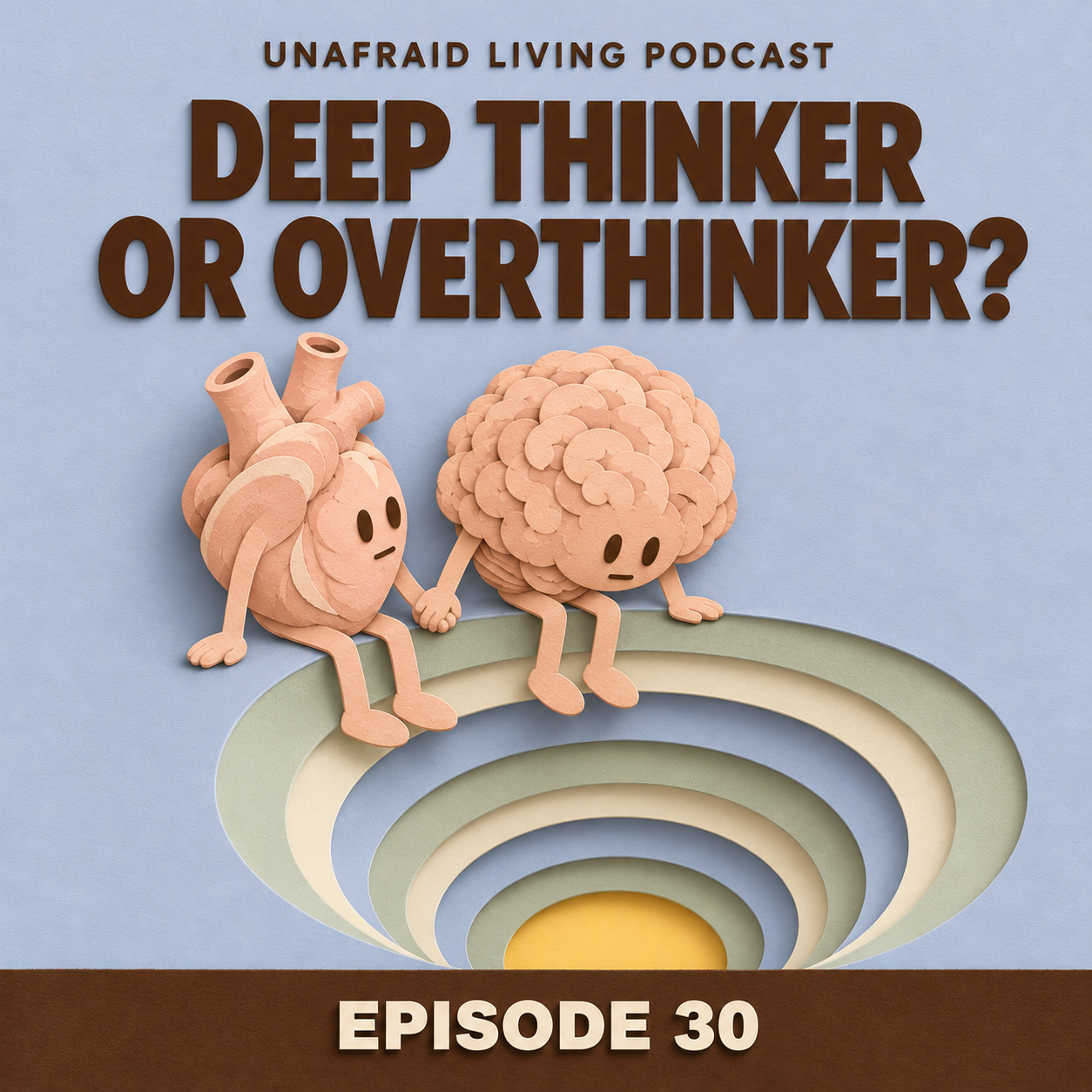
You've made a decision. You've considered the options, weighed the pros and cons, and decided what you're going to do. But then a thought creeps in. What if there's something I haven't considered?
Overthinking feels productive because your brain is still working on the problem. But there's a difference between making progress and going over the same information again and again. One moves you toward an answer. The other keeps you circling.
Sound familiar? You revisit the decision. Maybe you ask another friend for their opinion or spend another hour researching. You feel better for a little while, but then another question pops up. And before you know it, you're right back where you started.
Here's what's interesting. You may not actually need more information. You may be looking for something information can't give you: a guarantee that you're making the right decision.
That's where deep thinking can turn into overthinking.
I recognize this tendency in myself. I'm a slow decision-maker, especially when I'm shopping for clothes. I can take 30 things into a dressing room and spend far too much time assessing how they will fit into my wardrobe, then never buy a thing. And don't get me started on researching ingredients in products! I can spend unreasonable amounts of time making sure they don't contain any toxic ingredients.
The funny thing is, I'm not even classified as a Deep Thinker, but we all have a few characteristics of other profiles in us! I'm a people pleaser or "Harmonizer" but I do overthink more often than I'd like to admit.
What Is a Deep Thinker?
Some deep thinkers worry a lot and some hardly worry at all. What they all do is think a lot, and think deeply.
They're thoughtful people. They're perceptive and curious, they want to understand the why, and they ask really good questions. They dig beneath the surface. In a brainstorming meeting, they're the ones who say, "Have we thought about this?" and brings up the thing nobody else noticed. They anticipate consequences, they consider every side, and they're careful when a decision needs to be made.
If a deep thinker is your boss, they may make decisions slowly, and that might drive you a little crazy. But that care is often how they got where they are, and it's why they solve problems so well.
So I want to say this clearly before we go any further: being a deep thinker comes with a lot of good qualities. We aren't trying to talk anyone out of thinking. And what good would that do anyway? They're going to think regardless. But getting stuck in an overthinking loop doesn’t help anyone.
When Does Deep Thinking Turn Into Overthinking?
Here's where it can start to work against you. A deep thinker can find it hard to recognize when the thinking has stopped helping.
It can look like making a decision and then waffling, so you come back and think it all through again. It can look like rehearsing a conversation that hasn't happened yet, running every possible reaction. Will they take it well? Will they feel hurt, or rejected, or angry? Thinking through all those angles takes a long time.
It can look like research that never ends. That's wonderful if you're doing medical research. But if you're choosing which Little League team your kid should be on, at some point you have to decide, or the deadline passes and your kid misses out.
And for many of us, it looks like the 3 a.m. brain. Kim described it well: "Why didn't I say this? Should I say this? Am I going to say this?" I'd call that overthinking, since it may not be very deep when you're drifting in and out of sleep.
Why Does Your Brain Keep Searching After You've Thought It Through?
A big part of it is the need for certainty. Deep thinkers want to make wise decisions, and they reasonably believe that more information leads to better decisions. A lot of the time, that's true.
But some of us want more than information. We want a guarantee that the outcome will be what we want it to be. And for many deep thinkers, there's a black-and-white streak, the sense that there must be a right answer and a wrong one, so the gray areas are hard to live with. That's the all-or-nothing piece, and it can keep you going long after the useful information has run out.
Kim compared it to the little buffering circle on a screen. It keeps spinning, looking for something to connect to, and there's nothing there. Sometimes it quits, and sometimes it keeps going. Either way, you're stuck.
What makes this tricky is that sometimes there really is another piece of information out there. Your brain is right to look. The skill is noticing when you've gathered everything that's available, and the searching has turned into circling.
What Happens When Your Brain Fills in the Gap?
Dr. Daniel Amen coined the term automatic negative thoughts, or ANTs. There are nine of them, and two tend to give deep thinkers the most trouble: all-or-nothing thinking, which we just talked about, and fortune telling.
Fortune telling is what happens in the gap. When you don't have all the information, your brain is very good at filling in what's missing. It makes a prediction so you have something to work with. That's a useful ability most of the time.
The catch is that we all have a negativity bias. When the brain fills the gap, it tends to fill it with something less than good. So the longer you sit in a gap with no new information coming in, the more the story can tilt toward the worst version. And we can start treating those predictions as facts, even when we have no evidence that they're true.
That's why circling doesn't just waste time. It gives fortune telling more room to work.
What Can Thinking Do, and What Can't It Do?
Thinking gathers information and makes sense of it. It can help you weigh options and solve problems. It can help you prepare, and it can even inspire you.
There are also things thinking can't do. It can't guarantee how another person will respond, even if you find exactly the right words. It can't guarantee you'll make a perfect choice, or that things will turn out well. It can't make uncertainty disappear. And thinking can't take action. It can prepare you for action, but at some point you have to do the thing.
What it costs to keep circling is real. It can cost you time and opportunities. It can delay a phone call you know you need to make. I'll admit that if I got a diagnosis, I'd want to research every possibility before I listened to what the doctor said I should do. Information is good. Doing nothing with it is where the problem starts. And I've watched someone I love very much miss out on a relationship because they kept thinking about it instead of acting.
I used to pray for a neon sign from God. It never came. But I believe that when we go ahead and move, we can be directed. It's a lot easier to steer a moving ship than one that's stuck in the mud.
How Do You Know You've Crossed the Line?
The tricky thing about overthinking is that when you're in it, you still feel like you're figuring something out.
In my experience coaching, a lot of us carry a hidden requirement we've never said out loud. "I'll make the decision when I know this." "I can have that conversation when I know they're going to respond well." Until you pull that requirement out and look at it, it quietly runs the show. Once you say it, you often realize, "Oh. I can't know that." And then you can see that more thinking isn't going to get you there.
So here's the question I'd ask: am I still looking for information, or am I actually looking for a guarantee?
New information can open up a possibility or a question you hadn't considered. That's worth pursuing. But if you're gathering more because you want certainty, it may be time to accept that this one is uncertain. You can set it on a shelf, and sometimes that's the right call. Or you can decide that not acting would cost you more than acting, and take the risk. You've gathered a lot of information. You're probably in a better position to decide than you feel.
Can You Really Change an Overthinking Pattern?
Yes. Your brain is a pattern machine, and patterns can change. I talked in the Harmonizer Series about how people pleasing used to be a big problem for me, and how that changed. The same is true here. It takes practicing a different response over and over again.
I want to be careful about one thing, because you'll hear it all over social media: that every thought you have changes your brain. It's more accurate to say that repeated patterns of thinking and consistent behavioral changes help create lasting changes in the brain. We all have fleeting thoughts. One funny thought won't turn you into a comedian. But if you start thinking funny thoughts all the time, you might eventually grow into that role.
That can sound like a lot of work, and at first it can be. But it gets easier. In the course we talk about the tipping point, when something you've been practicing starts to feel natural. One day you realize, "Oh, I'm just doing this now." For a deep thinker, making a decision without every piece of information feels risky at first. That's how the brain training starts, and over time you start seeing good results from it.
The thinking is fine. It's the circling that costs you.
Your Practice
Start noticing when you're circling, because noticing is the first step in changing anything. You can't practice a different response until you notice the one your brain has been practicing.
When a thought keeps coming back around, ask yourself: do I have any new information to add, or am I just trying to feel sure?
If you have new information, keep thinking. But if you're going over the same information, hoping to feel more certain, recognize what's happening. You're circling, not moving forward.
More thinking isn't always the answer. Sometimes the next step is to stop thinking and start doing.
Download the free printable practice worksheet — one page, no email required:
[Download the Practice Worksheet (PNG)]
---
Ready to Go Deeper?
The UNAFRAID course gives you the brain-based tools to notice when your thinking has started circling and practice a different response — one small shift at a time.
👉 Take UNAFRAID, the full course ($197), or start with the first two modules for $37 at unafraidcourse.com
Start with The Hidden Fear Profile Quiz — it shows you which fear pattern is running the show:
unafraidliving.com/quiz
Coming next: mindfulness, then trust, wisdom and playfulness — four virtues that help a deep thinker's brain.
More from the Unafraid Living Podcast:
🔗 Episode 17: Why Your Brain Replays Conversations at 3am (And a 3-Step Way to Stop the Loop) [link when live]
🔗 Episode 24: What Is Wrong With Me? The Question Your Brain Treats Like a Verdict [link when live]
🔗 Episode 25: What Is a People Pleaser? The Harmonizer Pattern and Why It Wears You Out [link when live]
Frequently Asked Questions
What is the difference between deep thinking and overthinking?
Deep thinking takes in information and moves you toward a solution, a decision, or even just a place to rest. Overthinking keeps going over the same information without anything new coming in, so you end up back where you started. A helpful check is to ask whether you're still adding new information, or just trying to feel sure.
What is a deep thinker?
A deep thinker is someone who thinks a lot and thinks deeply. They tend to be thoughtful, perceptive and curious, they ask good questions, and they notice consequences other people miss. It's one of the five patterns in The Hidden Fear Profile Quiz. The strengths are real; the struggle comes when the thinking keeps going after it has stopped being useful.
Why can't I stop overthinking?
Often it's because part of you is looking for certainty, a guarantee that a decision or conversation will turn out the way you want. Thinking can prepare you, but it can't guarantee an outcome, so the search never quite finishes. In my experience coaching, naming the hidden requirement ("I'll decide when I know…") helps you see when more thinking won't get you there.
What is fortune telling in overthinking?
Fortune telling is one of the automatic negative thoughts, or ANTs, that Dr. Daniel Amen described. When you don't have all the information, your brain fills in the gap with a prediction. Because we all have a negativity bias, those predictions tend to lean negative, and they're rarely right. The longer you circle without new information, the more room fortune telling has to work.
Is rumination the same as overthinking?
Rumination is a kind of overthinking: the same thoughts circling without new information coming in. It often shows up at night, when you replay what you said or rehearse what you'll say. Deep thinking brings in new information and the thoughts change; rumination keeps returning to the same place.
How do I stop overthinking a decision?
Start by noticing when you're circling. Ask, "Am I still looking for information, or am I looking for a guarantee?" If there's something new to learn, keep going. If not, set it down for now and come back when you have more to work with, or decide that waiting would cost you more than acting, and take the step.