Why You Notice Everyone's Mood But Your Own (The Brain Science of Self-Awareness)
Have you ever walked into a room and known within two seconds who was comfortable, who was bored, and who didn't like what the last person said? If you have, I'm guessing you're a Harmonizer.
I'm one, and I have to admit my awareness is usually pointed outward. If my husband walks in the door in a foul mood, I notice right away. But some mornings everything seems to be going along fine, and then he says, "Do you have a headache?" That's his kind way of asking whether I'm in a mood. The thing is, until he mentioned it, I hadn't noticed.
That's the strange thing about self-awareness. You can be incredibly perceptive about everyone else and still miss what's happening in you.
Self-awareness is noticing your own thoughts, feelings and patterns while they're actually happening. And if you've spent years paying attention to what everyone else needs, wants or feels, you may simply have had a lot more practice noticing them than noticing yourself.
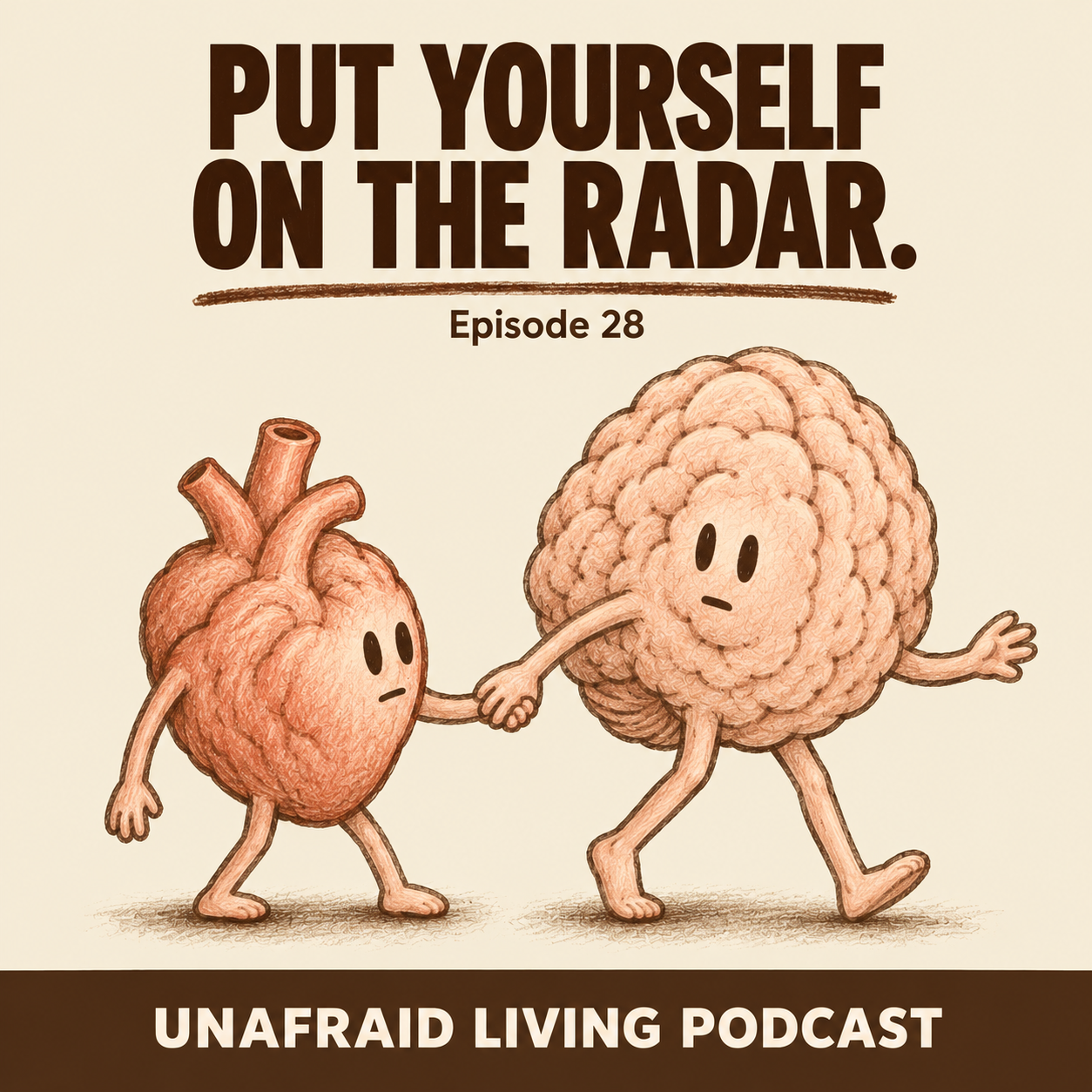
In Episode 28 of the Unafraid Living podcast, Kim and I talked about how we start turning some of that attention inward — not so we become more self-focused, but so we include ourselves in the information we're already so good at noticing. It's the fourth episode in our Harmonizer series, so if you took the quiz and came out a Harmonizer, this one's for you.
What Is Self-Awareness, Really?
Self-awareness is noticing your own thoughts, your own feelings and your own patterns while they're happening. That last part matters. Figuring it out three days later has value, but the goal is to catch it in the moment.
Kim asked me something in the episode that I think is worth noting. She said sometimes she knows she's in a bad mood and just ignores it. Is that the same thing? I don't think so. When you ignore a feeling, you're aware of it. You know it's there and you're choosing to pretend it isn't.
What I'm talking about is the other experience, where you honestly don't realize you're being a little snippy or a little short until someone else points it out. You can be very perceptive and still miss yourself entirely. Noticing the room and noticing yourself are two different skills, and you may have spent a lot more years practicing the first one.
Why Do People Pleasers Notice Everyone But Themselves?
Harmonizers are some of the most perceptive people I know. They walk into a meeting and notice whose eyes are puffy (maybe from crying or lack of sleep?), whose RBF is in full force, and who's bothered by what the speaker just said. That's a real strength and I'd never want to take it away from anyone.
Your brain gets better at noticing what you repeatedly pay attention to. If you've spent years watching other people's faces, your brain has gotten very good at reading their moods. It has had much less practice at reading yours.
You may not even realize you're tense or anxious until your shoulders start aching. You don't notice you're getting overwhelmed until you're crying in the bathroom. Or you spend the whole evening aware that someone else seems off and don't notice that you're feeling apprehensive too.
That's why self-awareness takes practice. You're not trying to stop noticing other people. You're learning to include yourself in what you notice
What Is Your Brain Doing When You Don't Notice What You're Feeling?
Your brain is taking in information from inside your body all the time — your heart rate, breathing, muscle tension, that flutter in your stomach. There's actually a name for your brain's ability to sense and interpret what's happening inside your body: interoception.
But just because your brain is receiving those signals doesn't mean you're consciously paying attention to them.
Think about where a Harmonizer's attention tends to go. Someone walks into the room and you notice their face, their tone of voice, the way they answered you. Meanwhile, your own shoulders may be tightening or your stomach may be doing a little flip, and those signals don't get nearly as much of your attention.
That's one reason the pause matters. It gives you a chance to turn your attention inward long enough to ask, What's happening in me right now?
At first, you may not have an answer. That's okay. You're practicing noticing something you've probably spent a lot less time noticing. And the more often you stop and pay attention, the more opportunity you have to catch those internal signals before you're crying in the bathroom wondering how you got there.
What Happens When You Pause and Nothing Comes?
This is the part people don't expect. You finally slow down, give yourself the pause, and your mind goes blank. You don't know what you feel. You don't know what to say, because you've never done it any other way.
I understand that one personally. After our first son went off to college, my husband and I went to a counselor. We were struggling, which is pretty normal at that stage. And the counselor said, "You two have no idea what you feel." He said he wasn't sure he'd ever met a couple where both the man and woman were so out of touch with their feelings. It was a little embarrassing! But we've both learned the value of naming our feelings.
There's actually a term for that: affect labeling. It simply means putting feelings into words. Instead of just feeling that knot in your stomach, you stop long enough to recognize, I'm anxious. Or I'm disappointed. I'm irritated. I feel guilty.
And naming the feeling can actually change what's happening in your brain. In research from Matthew Lieberman's lab at UCLA, putting feelings into words was associated with reduced activity in the amygdala in response to emotional stimuli and increased activity in a region of the prefrontal cortex involved in regulating emotional responses. In other words, naming what you're feeling can help take some of the intensity out of it.
When my stomach is fluttering and I don't know what to do, I practice by saying, "That's anxiety. Suzette, you're feeling anxious right now." Overwhelmed I already knew — my sister once told me I was one of the most overwhelmed people she'd ever met. But let me clarify — I was the mother of a baby and a toddler, running a business with my husband, who was in the depths of depression, and our business, our only stream of income, was failing. Sad and angry were so intertwined I couldn't tell them apart, but I have learned to stop long enough to sort out my feelings.
But if you pause and still come up blank, that's information too. You don't have to force an answer. Notice that you don't know. Sometimes the answer comes later. The point isn't to become brilliant at identifying every emotion. It's to start noticing yourself.
Is Self-Awareness the Same as Overthinking?
No. In fact, they can look similar at first because both involve paying attention to what's happening inside you. The difference is what happens next.
Self-awareness notices: I'm irritable today. I'm anxious. Something feels off. You don't necessarily have to figure out why. Sometimes simply recognizing your mood and putting a name to it is enough.
Overthinking keeps going. Why am I irritated? Was it what she said yesterday? Maybe she's upset with me. I probably shouldn't have said that. I wonder if she thought... Now you're no longer simply noticing what's happening in you. You're analyzing, replaying and trying to solve it.
That's an important distinction for a Harmonizer because we can be very good at overthinking other people's moods while still missing our own.
Self-awareness doesn't require you to dissect every feeling. Sometimes it's simply being able to say, I'm a little off today, and include that information in how you move through the rest of your day.
Does Noticing a Feeling Mean I Have to Act on It?
No. A feeling gives you information. It doesn't give you instructions.
If I notice that I'm irritated, that doesn't mean I need to tell everyone that what they're doing is irritating me. If I'm anxious, it doesn't necessarily mean something is wrong. And if I'm sad, I don't have to immediately figure out how to make myself happy.
Sometimes the best thing I can do is to be curious: I'm really irritable today. I wonder what's going on with me?
That little bit of awareness matters because now I know I'm bringing irritation into the room. Maybe I need to deal with something. Maybe I need some sleep. Maybe I don't know why I'm irritated yet. But at least I'm less likely to assume everyone else is the problem.
Your feelings are real, and they're worth noticing. But once you've noticed them, you still get to decide what you do with them.
Why Does Self-Awareness Matter So Much in Relationships?
It's funny. We're talking about self-awareness, but so much of what it helps is our relationships.
If you don't notice what you're feeling, you can't express it to anyone else. And if you can't express it, it's very hard for other people to really know you. A lot of people pleasers feel a little isolated, like nobody really knows them. We have to take some responsibility for that.
There's another side to it too. If I don't realize I'm irritated, I may be short with my husband without even noticing it. He hears the edge in my voice, but as far as I'm concerned, I'm fine. When I recognize what I'm feeling, I have a much better chance of deciding what I want to do with it.
Self-awareness gives me useful information: I'm irritated. I'm anxious. I'm overwhelmed. Now I can decide whether I need to say something, do something, or simply recognize that this is what I'm bringing into the room today.
The better I understand what's happening in me, the more harmonious my relationships can become. And for a Harmonizer, that's kind of the point.
Your Practice
I'll tell you up front that I'm not a big journaler. But I do journal when I have something specific I want to work on, and this is the kind of thing journaling can be really helpful for.
At the end of the day, think back over your day and pick one moment when you had a noticeable emotional reaction. Maybe you got irritated, felt anxious, became overwhelmed or suddenly felt like crying. Then write down:
What happened. Bullet points are fine — just enough to jog your memory later.
What were you feeling? Put a name to it if you can.
When did you first notice it? Right away? Twenty minutes later? When somebody else noticed it for you?
What did you notice in your body? Tight shoulders? Fluttering stomach? Clenched jaw? Nothing at all?
That's it. You're not trying to fix the feeling or figure out where it came from. You're practicing noticing yourself.
Does it have to be every day? Nothing has to be every day. I'm not a big rule follower. You don't need to be rigid about it. Do it often enough to practice, and don't turn self-awareness into one more thing you're supposed to be good at.
Over time, you may start catching what's happening in you a little sooner. And that's the whole point.
Download the free printable practice worksheet to track your progress — one page, no email required: Name It Notice It Practice
Ready to Go Deeper?
The UNAFRAID course gives you the brain-based tools to notice what's happening in you helping you to value your own feelings like you value other people’s feelings. Fearless Foundations ($97) at unafraidcourse.com
Start with The Hidden Fear Profile Quiz — it helps you identify exactly what's driving your patterns: unafraidliving.com/quiz
Explore the Harmonizer Series:
🔗 Episode 25: What Is a People Pleaser? The Harmonizer Pattern and Why It Wears You Out
🔗 Episode 26: Why You Assume Someone Is Upset With You (The Brain Science of Mind Reading)
🔗 Episode 27: Why It's Hard to Be Honest With Yourself (The Brain Science Behind "It's Fine")
Frequently Asked Questions
What is self-awareness?
Self-awareness is noticing your own thoughts, feelings and patterns while they're happening. It's different from being aware of other people. Plenty of very perceptive people can read a whole room and still miss that they're tired, irritated or overwhelmed. The goal is to include yourself in what you notice, in the moment, so you have real information before you decide what to do.
Why do people pleasers notice everyone else's feelings but not their own?
You get good at whatever you practice. If you've spent years watching other people for how things are landing, your brain has become very skilled at reading them and has had much less practice reading you. The good news is that attention can be trained in a new direction.
What is affect labeling?
Affect labeling is putting a name on what you're feeling — "I'm anxious," "I'm overwhelmed," "I feel guilty." Research from Matthew Lieberman's lab at UCLA found that naming a feeling tends to settle the brain's emotional reaction and bring more of the thinking parts of the brain into the process. In my experience coaching, it's one of the simplest and most useful habits a person can build.
What's the difference between self-awareness and rumination?
Self-awareness notices what's happening: I'm irritated. I'm anxious. Something feels off. Rumination keeps going — analyzing, replaying and trying to figure out why you feel that way. Self-awareness doesn't require you to dissect every feeling. Sometimes noticing it and putting a name to it is enough.
Does noticing a feeling mean I have to act on it?
No. A feeling gives you information. It doesn't give you instructions. Noticing that you're irritated, anxious or sad doesn't mean you have to immediately do something about it. Self-awareness gives you the chance to notice what's happening and then decide what, if anything, you want to do with that information.
How do I start becoming more self-aware?
Start small. When you notice an emotional reaction, pause and ask yourself, What am I feeling right now? Put a name to it if you can, and notice what's happening in your body. You don't have to fix it or figure out where it came from. You're simply practicing noticing yourself.