Negative Self-Talk: What's Really Happening in Your Brain (And the 9 Patterns Behind It)
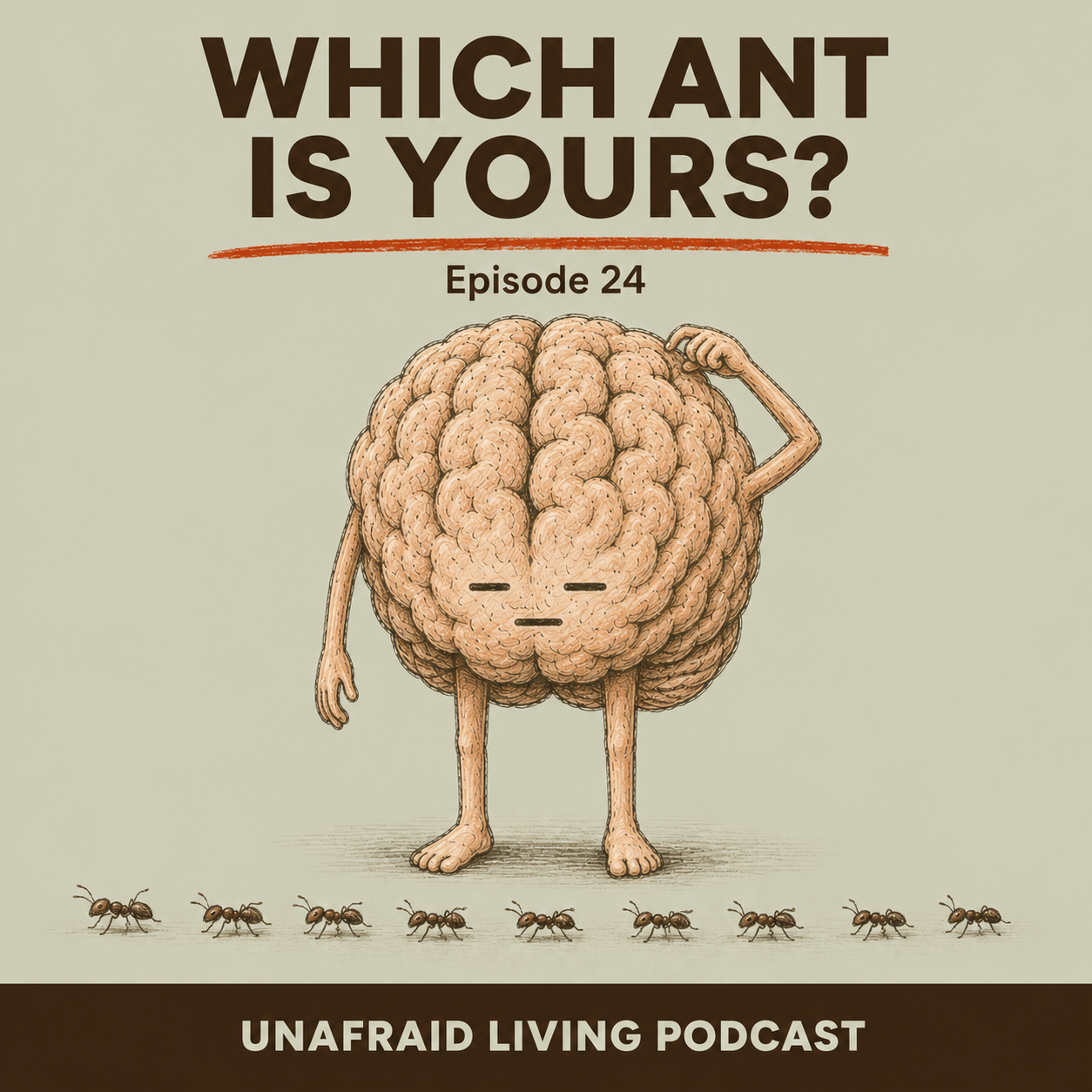
Negative self-talk is any internal dialogue that tears you down, predicts the worst, or keeps you stuck — and most of it runs on nine repeatable patterns that Dr. Daniel Amen named automatic negative thoughts, or ANTs. They feel like facts because you've thought them so many times that your brain now reaches for them without asking. The way out starts with noticing which ones are yours, because a pattern you can name is a pattern you can train. The aim is accurate thinking — honest about what's true and what isn't.
Here's something I've watched play out with clients. They are warm, generous, patient people. If a friend called them in tears at 10pm, they'd stay on the phone to listen and encourage. And then they'd hang up, lay down, and remember something they said wrong at work hours earlier, and speak to themselves with harshness they’d never use with a friend.
Kim opened this episode by naming it exactly: the things she says to herself, she would never say out loud to a friend.
In Episode 24 of the Unafraid Living podcast, Kim and I dug into where that voice comes from, what it does to your body, and the nine specific shapes it takes.
What Is Negative Self-Talk, Really?
I want to define this plainly, because I think most people draw the circle too small. Negative self-talk is more than being hard on yourself after you mess up. It's any internal dialogue that tears you down, predicts the worst, keeps you stuck, or manufactures guilt where there isn't any real guilt to be had. It's the comparing. It's the quiet running commentary you'd be embarrassed to have transcribed.
Anything that is negative about yourself is negative self-talk. I know that's plain and simple. I'd rather it be plain and simple than clever, because a definition you can actually apply in the moment is worth more than one you have to think about.
And the reason the circle matters: if you only count the obvious cruelty, you'll miss ninety percent of what's actually running.
Where Did These Thoughts Even Come From?
Some of it you were handed. A teacher's comment in a classroom. Something said at home, often by someone who wasn't thinking about how long it would last. A boyfriend or a girlfriend who said one sentence at seventeen that you're still carrying. The people we respect leave the deepest marks, which is a strange kind of compliment and a real kind of wound.
But a lot of it, honestly, is our own work. Nobody had to tell you that you weren't smart. You didn't do well in history and math, so you decided you weren't smart. (It's probably closer to the truth that you didn't enjoy history and math. Those are not the same thing.)
The same goes for relationships that ended badly. You decided it was all your fault. Maybe it had nothing to do with you — maybe the partner you thought you wanted had a girlfriend back home he went back to. I'm speaking from experience there.
So the material comes from two places: what we heard, and what we concluded.
Why Do Untrue Thoughts Still Change How You Feel?
The lie most people miss is thinking their thoughts are true. They're not always true. We lie to ourselves constantly, and because the thought goes unquestioned, it gets promoted. It starts functioning like a fact.
Here's the part that surprised me most in my training at Amen University: every thought triggers a neurochemical release. Positive, negative, accurate, wildly inaccurate — your body doesn't sort them at the door. Think it, and the chemistry follows. Your heart rate shifts. You start to sweat. Stress hormones rise.
Picture sitting at a dinner table where everyone is deep in a conversation about history, and you're running "I'm terrible at history" on a loop, praying nobody looks at you. Nothing has actually happened. And your body is reacting like something has.
That's why I say this is more than mindset. It's biology. Your thoughts shape how your body functions, which means they're worth taking seriously.
What Are the Nine ANTs?
Dr. Daniel Amen calls automatic negative thoughts ANTs, which I think is a genuinely great acronym — ants are nasty, they multiply, and they don't leave on their own. Here are the nine species:
All or Nothing. “If it's not perfect, it will be a disaster.” (No middle ground and no grace.)
Less Than. “I’ll never have what they do. What is wrong with me?
Just the Bad. "Twelve things went right today. All I can think about is the one that didn't."
Fortune Telling. “I'm going to bomb this interview.”
Mind Reading. “They didn't text back — they’re ghosting me on purpose."
Guilt Beatings. “I should be further along by now.”
Blaming. "I’d be good if they..."
If Only / I'll Be Happy When. “If only my parents had empowered me.” / When I get out of this situation I’ll be happy.”
Labeling. "I'm just an anxious person — that's how I am." OR "I've always been shy. I can't help it."
Pick three or four that feel most alive in your life. Nobody works on nine at once.
Which Ones Do the Most Damage?
Which ever one you let reign. But I'll tell you my honest opinion about a few. Guilt beatings and mind reading do more relationship damage than anything else on that list.
Every should is a small hammer. A hundred quiet taps, deepening a groove you already walk in every day.
And mind reading, my goodness. We are terrible at it and completely convinced we're excellent. Detectives and trained interviewers can read a face. The rest of us see an expression and invent an entire paragraph behind it, and then respond to the paragraph we invented. We damage real relationships this way, over faces that meant nothing.
All we had to do was ask. "You made a face — what's going on for you?" One question. That's it.
Comparison is the one that's hardest to escape, because your brain compares as a matter of course. It reads the room and figures out where you stand. That system works exactly as designed. What's changed is how much material we feed it.
Why Is Accurate Thinking Better Than Positive Thinking?
The goal here is accurate thinking. Positive thinking asks you to paste something cheerful over the top of a thought you don't believe, and some part of you always knows.
Accurate thinking asks a harder and better question: is this actually true? Say what you're thinking out loud, plainly, and look at it. Some of it will hold up. Much of it won't.
One shift I come back to constantly in coaching: you're reading your life through the lens of your worst day. Try reading it through the lens of the person who was your biggest cheerleader — a mother, a grandmother, a teacher who thought you hung the moon. That person saw your faults perfectly well and still saw the whole picture. Your worst day never did.
That's brain training. You're giving your thoughts room to change by changing the lens you examine them through.
How Do You Start Training These Patterns?
You do have a prefrontal cortex, and it can push back. Here's where I'd start:
- Name the thought out loud, in plain words. A thought said aloud is much easier to evaluate than one running silently.
- Ask whether it's true — and then ask whether it's true with total certainty. That second question does most of the work.
- Notice which of the nine species it belongs to. Naming the pattern takes it out of the "that's just how I am" category.
- Ask how you'd feel if you couldn't have the thought at all. Sit with that for a second.
- Turn it around to its opposite and check whether the opposite is as true, or truer.
- When you catch yourself mind reading, ask the actual question instead of answering it yourself.
And be patient with yourself when these pop up unbidden. They show up automatically because you've thought them before, many times. That's how the pathway got easy. Real change takes real effort, and it also takes a little grace.
Your Practice This Week
Just notice. That's the whole assignment.
This week, pay attention to which ANTs speak the loudest to you. You don't need to fix them, argue with them, or squash them. Meet the ant where it is, notice it, and keep going. If you want a starting point, pick three or four that felt most familiar as you read the list above and watch for those specifically.
I'd rather you notice honestly for seven days than try to fix everything for two.
Download the free printable practice worksheet to track what you notice this week — one page, no email required: [Download the Practice Worksheet (PDF)]
Download the free printable Ant Watch practice worksheet to track what you notice this week — one page, no email required:
Ready to Go Deeper?
The UNAFRAID course gives you the brain-based tools to change the way you talk to yourself — one small shift at a time.
Fearless Foundations ($97) at unafraidcourse.com
Start with the free Fear Profile Quiz — it helps you identify exactly what's driving your patterns:
More from the Unafraid Living Podcast:
🔗 Episode 19: Why Social Comparison Hurts So Much (The Brain Science Behind It and 4 Tools That Help)
🔗 Episode 20: Why You Get the Ick (And How to Know If It's Protecting You or Holding You Back)
🔗 Episode 21: Why Understanding Your Brain Matters Less Than Practicing
Frequently Asked Questions
What is negative self-talk?
Negative self-talk is any internal dialogue that tears you down, predicts the worst, keeps you stuck, or creates guilt where there's no real guilt. It's broader than most people assume — it includes comparing yourself to others, replaying old mistakes, and the quiet running commentary you'd never say out loud to a friend. Anything negative you say about yourself, to yourself, counts. Drawing the circle that wide is what makes the pattern visible.
What are ANTs in psychology?
ANTs stands for automatic negative thoughts, a term coined by psychiatrist Dr. Daniel Amen. They're reflexive, unexamined thoughts that show up on their own and make you feel sad, worried, guilty, or out of control. There are nine common species: all or nothing, less than, just the bad, fortune telling, mind reading, guilt beatings, blaming, if only, and labeling. Everyone has some of them — the research is clear on that.
Why do my negative thoughts feel so true?
Because you've thought them many times before. A thought that repeats becomes easier for your brain to reach for, until it arrives without any effort at all and shows up feeling like a conclusion rather than a guess. In my experience coaching, this is the single hardest thing for people to accept — that something can feel completely certain and still be inaccurate. Saying the thought out loud and asking whether it's true with total certainty is usually where that grip loosens.
Can a thought really affect your body?
Yes. Every thought triggers a neurochemical release, whether the thought is accurate or not. That's why an old memory can raise your heart rate, or why worrying about a conversation you haven't had yet leaves you sweating. Your body takes its cues from what you're thinking. This is one of the reasons I treat self-talk as a health issue and not only an emotional one.
How do I stop negative self-talk?
Start by noticing rather than fixing. Pay attention to which of the nine patterns show up most for you, and name them as they happen. From there, ask whether the thought is true, and whether it's true with total certainty. Aim for accurate thinking rather than positive thinking — honesty about what's real works better than cheerfulness you don't believe. It takes repetition, because you're training a pattern that took years to build.