Does Grounding Actually Work? The Brain Science Behind Earthing and Emotional Calm
Does Grounding Actually Work? (The Brain Science Behind Earthing and Emotional Calm)
Quick Answer: Grounding works — both the physical kind (walking barefoot, using a grounding mat) and the emotional kind (heart-focused breathing, pausing mid-stress). How do we know? It’s visible on a biofeedback monitor. They work because they both activate the same calming pathway in your body: the vagus nerve and your parasympathetic nervous system. Physical grounding enters through the body; emotional grounding enters through the mind. When you combine them — I call it full spectrum grounding — you're calming your nervous system from every direction at once. You only need five minutes.
Here's something I'll admit freely: for years, when I turned over in bed in the winter, sparks would fly. Literally. Static electricity everywhere. Eventually I got a grounding mat just to see what would happen. My husband thought I was exaggerating until I asked him to take note. The sparks had stopped. Completely.
That was my first clue that there was a connection to the kind of grounding I talk about, emotional grounding to physical grounding. I'd never before connected them. When Kim asked me to go deeper on this topic, I started pulling the research, and what I found surprised me. These two things I'd been treating as separate — the earthing stuff and the mindset work — but they are actually doing the same thing. They're using two different doors to get to the same room. Side note: I “earth” with a grounding mat.
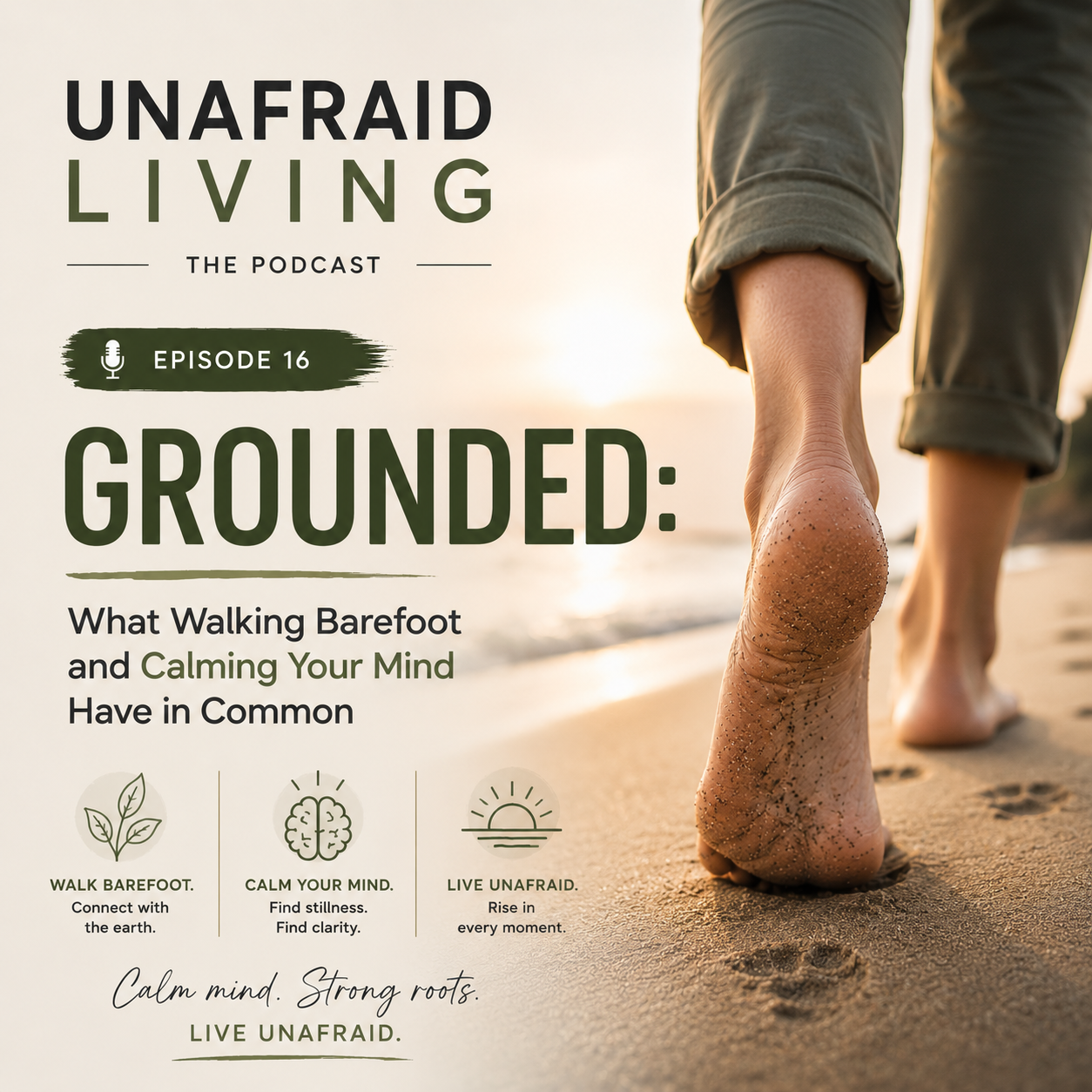
In Episode 16 of the Unafraid Living podcast, Kim and I dug into exactly what those two doors are, how they connect, and why using both at the same time might be the simplest thing you do this week for your brain and your body.
Physical Grounding and Emotional Grounding Are Working on the Same System
When most people hear "grounding," they think of one or the other. Physical grounding — earthing — is about your bare skin making contact with the earth. Feet in the grass. Hands in the dirt. Sleeping on a grounding mat. Emotional grounding is what we talk about all the time on this podcast: the pause, the pivot, the breathing, catching your automatic negative thoughts before they run the show.
They seem completely unrelated. But here's what's fascinating: they both work through your nervous system — specifically through the vagus nerve and the parasympathetic nervous system, which is your body's built-in calming mechanism.
Physical grounding enters through the body. Emotional grounding enters through the mind. But both are telling your brain the same thing: You are here. Right now. In this moment. You're safe.
Kim said it well during our conversation: it's like two doors to the same room. And the beautiful thing is you can walk through both doors at the same time.
The Real Science Behind Walking Barefoot (It's Not Just a Feeling)
Why it matters: Your ancestors grounded constantly — barefoot in the grass, hands in the soil, sleeping on the earth. We've insulated ourselves so completely from the ground that we've lost something our nervous systems depended on.
The earth carries a mild negative electrical charge on its surface. When your bare skin makes direct contact with the ground — feet in the grass, hands in the dirt — electrons transfer from the earth into your body. Those electrons help neutralize free radicals: the unstable molecules that drive inflammation and cellular stress. The electricity in your body, in a very real sense, gets grounded.
This isn't just a TikTok wellness trend. The research is real, and it's growing. Studies have found that earthing can lower cortisol — your primary stress hormone. A 2025 double-blind trial out of Korea found that participants who slept on real grounding mats slept longer, reported less insomnia, and had less daytime sleepiness compared to the group using fake mats. Animal studies show less stress in animals who use grounding mats. Even one hour of grounding has been shown to improve blood flow and reduce inflammation markers.
I want to be clear — this isn't my area of expertise, and the research is still developing. A healthy dose of skepticism is always good. But the direction of the evidence is consistent: physical contact with the earth calms the nervous system. And that's not a small thing.
What about grounding mats? I use one, and here's how it actually works. Every electrical outlet in your home has three holes — that small bottom hole is the grounding hole. It connects via a wire that runs all the way down into the earth. It's a safety feature that gives excess electrical energy a path to complete its loop. A grounding mat simply plugs into that one hole — not as a plug using electricity, just borrowing that existing earth connection. When you lie on the mat, you're completing the same loop you'd complete standing barefoot outside. You just do it through your home's grounding wire.
Loops — sound familiar? Your brain works the same way. Those ruminating thoughts — those loops we keep coming back to — they're also looking to be completed. Looking to be grounded.
Emotional Grounding: What It's Actually Doing in Your Brain
If you've been listening to this podcast for any length of time, we hope you've already been practicing emotional grounding.
When you do heart-focused breathing, you're grounding. When you pause and pivot instead of reacting, you're grounding. When you catch an ANT — an automatic negative thought — before it hijacks your afternoon, you're grounding. All of it is doing the same thing: pulling your brain back into the present moment, back into safety, back into clarity.
Here's the brain science. When you're stressed or overwhelmed, your amygdala — the alarm system in your brain — fires up and takes the wheel. Your prefrontal cortex, the thinking brain right up front behind your forehead (I think of it as the CEO), goes quiet. You lose access to your best judgment, your best words, your best responses.
Why it matters: When therapists or coaches say "you need to take a minute and get grounded," what they mean is: come back to now. Get out of the fear loop. Get out of the what-if loop. Bring your brain back to this moment, this breath, this room.
When you do that — through breathing, through pausing, through any grounding technique — your prefrontal cortex comes back online. The amygdala quiets. You get access to yourself again.
The key player connecting all of this is the vagus nerve. It's a long nerve that runs from your brainstem all the way down through your chest and into your gut — the main communication highway between your brain and your body. It's the key player in your parasympathetic nervous system, the rest-and-digest system that calms everything down.
Slow, intentional breathing stimulates the vagus nerve. So does physical earthing. Both through different doors — both activating the same calming pathway.
Full Spectrum Grounding: Using Both Doors at Once
This is where things get powerful.
When you combine physical grounding and emotional grounding at the same time, you're addressing your nervous system from both sides simultaneously. Your body is receiving electrons from the earth, lowering cortisol and reducing inflammation — calming from the ground up. Your mind is getting into coherence through heart-focused breathing — calming from the top down.
Coherence is worth understanding. HeartMath (heartmath.com) has done extensive research on what happens when your heart and brain sync up. When they're in coherence, the other systems in your body sync up too. Your body stops fighting itself. It responds instead of reacting. You feel that — and your brain performs better for it.
I do this every morning, and I'll tell you it has changed how my days start. I combine the grounding mat at night with gratitude and visualization before sleep. In the morning, it's the breathing, the heart focus, the intentional thought about what I want the day to be. Is my version complicated? Not really. But I'm not suggesting you need that level of routine to get the benefit.
Just five minutes. That's it.
How to Try Full Spectrum Grounding (5 Minutes, That's All)
You don't need a mat. You don't need a program. Here's all it takes:
- Step outside barefoot — grass or dirt is best, but concrete works to a degree.
- Stand still for a moment. Feel your feet touching the ground. Wiggle your toes. Just notice what that feels like.
- Slow your breathing — just a little slower and a little deeper than usual.
- Bring your attention to the area around your heart.
- Think of something you're genuinely grateful for — this puts you into coherence.
- Do this for five minutes before you check your phone.
That's full spectrum grounding. Body calming from the ground up. Mind calming from the top down. It's free. It requires no equipment. And it works for everyone — regardless of where you're starting from, what you're carrying, or how stressed your mornings usually are.
If you live in an apartment or can't get outside? A grounding mat is worth the investment. Or step outside barefoot on your lunch break — you shouldn't be staying inside all day anyway. Outside is genuinely good for your brain. By the way I LOVE being outside, but I like my mat because apparently I’m full of electricity and prefer not to light up the room every time I roll over!
Grounding isn’t complicated. It's just hard to remember to do.
Your Practice This Week
This week, I want you to try full spectrum grounding — just one week, five minutes, before you check your phone. Step outside barefoot. Breathe slowly. Focus on your heart. Think of something you're grateful for. That's it. Then notice. You might not feel a massive shift on day one — but give your nervous system a few days of it, and then pay attention to how you're sleeping, how your mornings feel, whether the day starts just a little less rushed. Your nervous system is always listening. Give it what it needs, and your brain will do the rest.
Ready to Go Deeper?
The UNAFRAID course gives you the brain-based tools to quiet fear and build resilience — one small shift at a time.
👉 Fearless Foundations ($97) at unafraidcourse.com
Take The Unafraid Profile — a free 3-minute quiz that reveals how fear and anxiety show up in your brain, plus practical tools to start rewiring the pattern.
🎧 Listen to Unafraid Living Episode 16 wherever you get your podcasts.
Follow @unafraidliving on Instagram, TikTok, Facebook, and YouTube.
More from Unafraid Living:
Say It Unafraid Series (Episodes 10–15 — Complete):
🔗 Episode 10: Why Communication Breaks Down
🔗 Episode 11: Better Questions Without Starting a Fight
🔗 Episode 12: Stop Being Defensive (Unafraid Listening)
🔗 Episode 13: Set Boundaries Without Guilt
🔗 Episode 14: Stay Calm When Emotions Take Over
🔗 Episode 15: How to Repair a Conversation After It Goes Wrong
Frequently Asked Questions
Does walking barefoot really calm your nervous system?
It does — and there's measurable science behind it. When your bare skin contacts the earth, electrons transfer into your body and help neutralize free radicals, which drive inflammation and cellular stress. This exchange also lowers cortisol, your stress hormone, and stimulates the vagus nerve — the main nerve that activates your body's calming system. It's not just a feeling. The effect is real and it compounds the more consistently you practice it.
What is the difference between physical grounding and emotional grounding?
Physical grounding is about your body making contact with the earth — barefoot in the grass, hands in soil, a grounding mat at home. Emotional grounding is about bringing your mind back to the present moment — through breathing, pausing, or any technique that quiets the alarm system in your brain. They feel like completely different things, but they work through the same pathway: the vagus nerve and your parasympathetic nervous system. Physical enters through the body; emotional enters through the mind. Both get you to the same place.
How does a grounding mat actually work if you're inside?
The small bottom hole in every electrical outlet in your home is the grounding hole — it connects via a wire running into the earth as a safety feature. A grounding mat plugs into just that one hole. It doesn't use any electricity — it only borrows that existing connection to the earth. When you lie on the mat, your body completes the same loop it would if you were standing barefoot outside. The electrons have a path to travel, and your body gets the benefit.
What does the vagus nerve have to do with grounding?
The vagus nerve is the long nerve that runs from your brainstem all the way through your chest and gut — it's the main communication highway between your brain and your body. It's the primary driver of your parasympathetic nervous system (rest and digest). Slow intentional breathing stimulates it directly. Physical earthing also stimulates it through the nervous system response in your skin and body. Both types of grounding activate it. That's why both types of grounding produce the same calming effect.
How long do you need to ground to feel a difference?
Start with five minutes. That's a reasonable, achievable anchor. You may not notice a dramatic shift on day one, but give your nervous system a few consistent days of it — and then pay attention to your sleep, your mornings, your baseline stress level. The research on earthing shows measurable effects even with one hour of grounding, and studies on heart-focused breathing show the shift happens quickly once your body gets the pattern. The goal isn't a big experience. It's a small, consistent signal to your nervous system that you're safe.