Why Your Brain Replays Conversations at 3am (And a 3-Step Way to Stop the Loop)
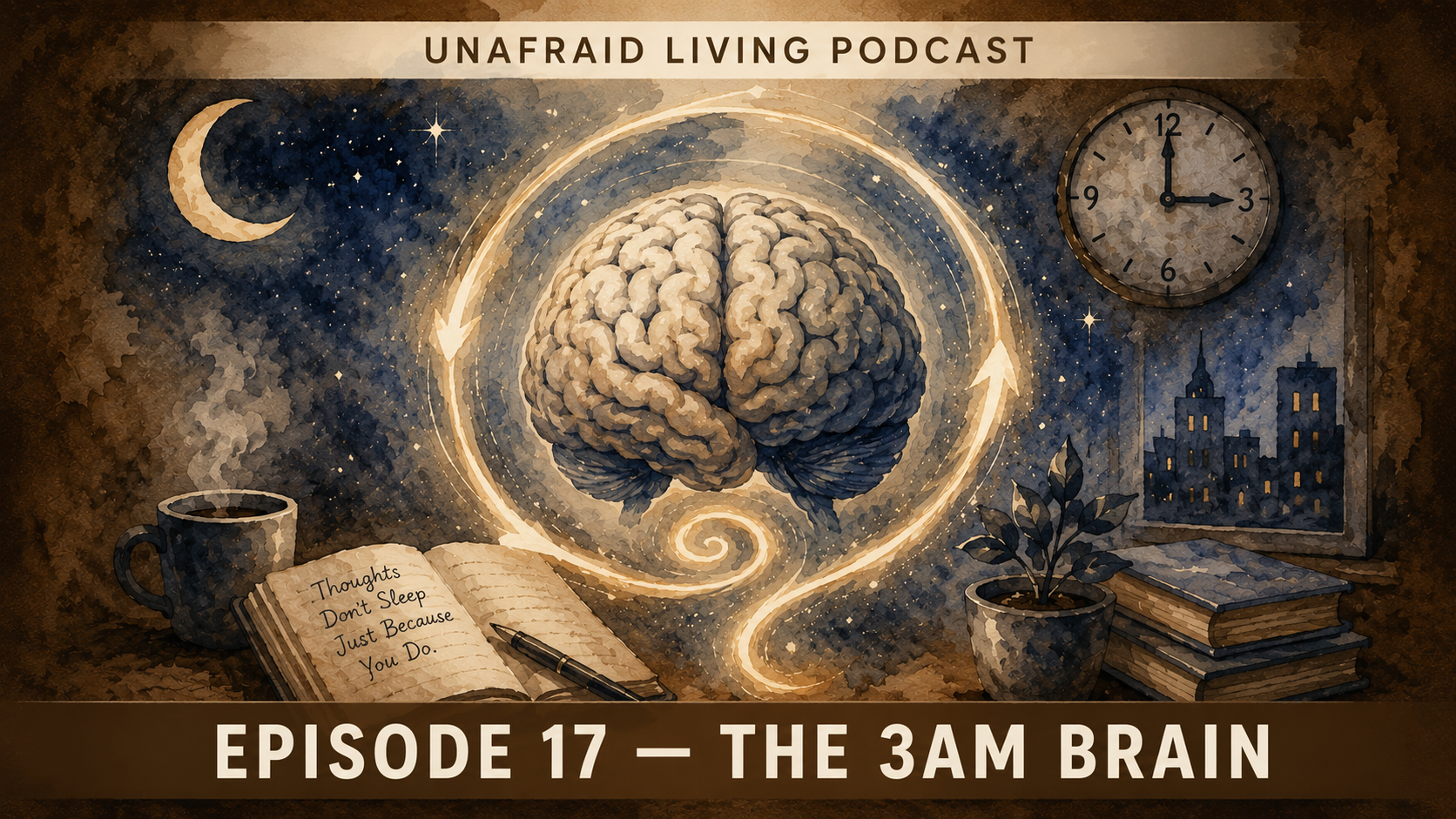
Quick Answer: When your brain replays a conversation over and over — especially at night — it's called rumination, and it's your default mode network running a search query on incomplete data. Your brain flagged the conversation as unresolved and keeps looping back to it trying to find an answer. To stop the loop, you need to calm your heart rhythms first (heart-focused breathing), then get the thoughts out of your head onto paper (a data dump), and finally ask whether there's a real conversation that needs to happen. You are not your brain — you can teach it new patterns.
Here's something I know about you: you've been there. Maybe it was a conversation with your boss, your mom, a friend. It ended, the day moved on, and then somewhere around 3am your brain decided to pull up a chair and replay the whole thing — what you said, what they said, what you should have said, what it probably meant.
I've been there too. And not just once. I had a thought loop that lasted nine years. I'm not exaggerating — I'll tell you about it in a minute, because I think it might make you feel less alone in yours.
In Episode 17 of the Unafraid Living podcast, Kim and I dug into exactly what's happening in your brain and heart when this replay won't stop — and more importantly, a three-step method to interrupt it.
What Rumination Actually Is — And Why Your Brain Does It on Purpose
Why it matters: Your brain isn't torturing you. It's running a search that hasn't found an answer yet — and it won't stop until it does.
The clinical term is rumination, but think of it as your brain getting stuck in a loop. Like a song you can't turn off. And here's the thing most people don't realize: your brain is doing this because it's trying to help you.
Your brain has a background program called the default mode network. Think of it like the apps running on your phone when the screen is off — still processing, still working, even when you don't know it's happening. This network is designed to help you make sense of your social world. It replays experiences, tries to understand what happened, and tries to predict what's coming next.
When a conversation ends in a way that feels unresolved — you're not sure where you stand, you don't know what the other person really meant, maybe something stung a little — your brain flags it as incomplete data. And incomplete data is a problem your brain wants to solve. So it keeps going back to it, replaying it, analyzing it, trying to fill in the gaps.
The problem? Replaying the same incomplete loop doesn't give your brain any new data. It just reinforces the loop — which, by the way, is almost always negative. Positive thought loops can happen, but they're almost always learned, conscious responses. The ones that play automatically at 3am? Those trend dark.
Neural Ruts: Why the Loop Gets Harder to Stop
Why it matters: Every replay digs the pathway deeper, turning a single thought into an automatic one.
Kim and I have talked about neural ruts in previous episodes, and they show up powerfully here. Every time that thought loop plays, the neural pathway gets worn deeper — like a tire track in mud. After a few days, the thought can feel automatic. It just appears without you choosing it. Everything seems to trigger it.
That's when a single loop becomes what Dr. Daniel Amen calls an ANT — an automatic negative thought. And when you're in a ruminating loop, two kinds of ANTs tend to show up most.
The first is mind reading. That's when you decide you know what the other person is thinking or feeling — even though they never actually said it. "She seemed annoyed, so she must be angry at me." "He didn't respond the way I expected, so he clearly thinks I'm overreacting." Your brain fills in the blank with the worst-case interpretation, then treats that interpretation as fact. And then it starts to loop on a version of events that you made up.
The second is fortune telling — predicting a negative outcome as if it's already been decided. "We're never going to recover from this fight." "She's going to tell everyone what I said." "This is going to affect my job." Your brain starts treating a fear about the future as though it has already happened. These fears feel real because that's what you're telling your brain — and your brain doesn't know the difference until you stop and ask it - is this true?
What Your Heart Is Doing While Your Brain Loops
Why it matters: The chaos isn't just in your head. Your heart is sending erratic signals to your brain, and that makes it so hard to think your way out — it feels like chaos. These are physical, electrical signals originating in your heart that are being sent to your brain.
This is a piece most people miss entirely. Your emotions can be measured electrically, and they come from your heart — not your brain. Your heart is your emotional center of gravity. And here's what most people don't know: your heart talks to your brain more than your brain talks to your heart.
When you're emotionally distraught — when the loop is running hot — your heart sends chaotic signals to your brain. That makes it harder to think clearly, harder to remember things accurately, and harder to access rational thought. So the loop doesn't just feel bad — it genuinely impairs your ability to reason your way out.
And it may not show up the way you expect. It's not always a racing heart or sweaty hands. What's actually happening is your heart rhythms are becoming chaotic — your heart rate variability gets disrupted. You can see this on a biofeedback device, a smartwatch, or an EKG. The rhythm itself is off, even if the heart rate seems normal.
This is exactly why trying to think your way out at 3am doesn't work. You need a calm heart to get clear thinking. One step at a time creates steady progress and lasting change — and the first step is calming the heart.
The 3-Step Loop Interrupt
Here's what actually works. Not perfectly every time, but consistently enough that it will become your go-to.
Step 1 — Heart-focused breathing. Shift your attention to the area around your heart. You can put your hand on your heart — it helps you stay focused. Breathe in a little slower and a little deeper than usual, in for about five seconds, out for about five seconds. Don't count the seconds if it stresses you out — just a little slower and deeper than normal. And as you breathe, bring to mind something you're truly grateful for. A person, a pet, a place that feels safe. Someone who loves you.
This isn't relaxation for relaxation's sake. The studies through HeartMath show that when you combine heart-focused breathing with a genuine feeling of gratitude, your heart rhythms become steady and rhythmic — and every system in your body starts to get into coherence. Your brain gets clearer signals. It's physiology, not magic. I don't even look at a clock anymore. I just count breaths — 25 if I'm at home doing quiet time, maybe 3 if I'm mid-conversation and just need to squeeze them in.
I'll be honest about something personal here: heart-focused breathing helped me get off my blood pressure medication entirely. I had dangerously high blood pressure — a doctor once kept me for hours and nearly sent me to the ER. After consistent practice, my blood pressure normalized, even in a doctor's office with the white coat effect. When I let the habit drop, it rose. This is pretty common but what happened with my 88 year old father-in-law was new to me. He was able to reduce Afib episodes drastically. (Always consult your doctor before making changes to your medication.)
Step 2 — The data dump. Once your heart has calmed down, grab something to write on — paper, your phone, your notes app. Write down everything your brain is looping on. Not to analyze it, not to figure it out — just to get it out of your head and onto a page where you can look at it more objectively. This gives your brain permission to stop holding onto it. It's on paper now — you're not going to forget it. And sometimes, when you see the thought written out, the ANT loses its power. "She's definitely angry at me" looks a lot less certain when it's written in front of you.
If you're in bed and already starting to calm down — you don't have to get up. Just go back to sleep. But if the loop is persistent, the data dump can break through.
Step 3 — Conversation, not confrontation. A lot of the time, the loop won't stop because something genuinely needs to be resolved. Part of your brain knows it — there's a gap, and the circuit won't complete until you fill it. But instead of moving toward the conversation, we avoid it. We're afraid of conflict.
Ask yourself one question: is there a conversation I need to have? Not a confrontation — just two people clearing something up. You don't need a script. You don't need to be perfect. You just need to be willing, and you need to be kind.
And sometimes even making a plan — "I'll reach out tomorrow" — is enough to quiet the loop for the moment, because your brain finally knows what the next step is. The data isn't complete yet, but there's a plan, so you can rest.
My Nine-Year Loop
I want to share this because I think it shows how powerful rumination is — and how unnecessary the suffering can be.
I was nine years old. My cousins and I were upstairs in their house in Texas, just talking, and my cousin — I love him dearly — said something that stung. I don't even actually remember the original words. But I distinctly remember the looping thoughts. I couldn't stop thinking about it.
That loop didn't leave me until we were at the same college together. Nine years. Half my life at that point. My brain was trying to protect me, to prepare me for the next time we'd all be together — but replaying the same incomplete data over and over never gave it the answer it was looking for.
If I had talked to him when I was little — if I had understood how much he adored me and what he really meant, heard an apology, or even cold hard truth — the loop would have stopped. I would have gotten the information my brain needed to complete the circuit. But I avoided that conversation, and the loop just kept going.
Pause and pivot. That's what I wish I'd known at nine, and 10-18!
Your Practice This Week
The next time your brain pulls up a conversation on repeat — try the three-step interrupt. Heart-focused breathing first: five counts in, five counts out, and bring to mind something you're grateful for. If the loop persists, do a data dump — write it all out, not to solve it, just to get it out of your head. And then ask: is there a conversation I need to have? Even making a plan for when you'll have it can be enough to let your brain rest. One step at a time creates steady progress and lasting change.
Ready to Go Deeper?
The UNAFRAID course gives you the brain-based tools to break free from looping thoughts and build new patterns that serve you — one small shift at a time.
👉 Fearless Foundations ($97) at unafraidcourse.com
Take The Unafraid Profile — a free 3-minute quiz that reveals how fear and anxiety show up in your brain, plus practical tools to start rewiring the pattern.
🎧 Listen to Episode 17 wherever you get your podcasts.
Follow @unafraidliving on Instagram, TikTok, Facebook, and YouTube.
FAQ
Why does my brain replay conversations over and over again?
Your brain has a background program called the default mode network, and it's designed to process unresolved social experiences. When a conversation ends in a way that feels incomplete — you're not sure where you stand or something stung — your brain flags it and keeps replaying it, searching for a resolution. It's not a flaw. It's your brain doing its job, just not very efficiently.
What is rumination and is it normal?
Rumination is your brain getting stuck in a negative repetitive thought loop — replaying the same experience trying to make sense of it. It is completely normal — everyone does it. The problem isn't that it happens — the problem is you haven’t know how to stop it.
How do I stop overthinking at night when I can't sleep?
Start by calming your heart rhythms with heart-focused breathing — breathe in for about five counts, out for five counts, and bring to mind something you're grateful for. If the loop persists, write down what's on your mind to get it out of your head. Then ask yourself if there's a real conversation you need to have. Even just making a plan for that conversation can quiet the loop enough to sleep.
What are looping thoughts and why can't I stop them?
Looping thoughts happen when your brain treats an unresolved experience as an open problem and keeps running a search for an answer. Each time the loop plays, the neural pathway deepens — making the thought more automatic and harder to stop. Two common thinking patterns — mind reading (assuming what someone thinks) and fortune telling (predicting a negative outcome) — tend to fuel these loops with worst-case interpretations that feel real but usually aren't.
Does heart-focused breathing actually work for racing thoughts?
Heart-focused breathing works by calming your heart rhythms, which in turn sends clearer signals to your brain — allowing you to think more rationally. When your heart rhythms are chaotic (during stress or overthinking), your brain can't access clear thinking. Research shows that combining slower breathing with a feeling of gratitude creates measurable coherence between your heart and brain. It doesn't fix the situation, but it creates enough calm to use the tools that do.