When Your Brain Makes Something Temporary Feel Permanent
Why intense distress can narrow what you are able to see—and why you should not face it alone
There are moments when your life can feel as if it has collapsed into one painful conclusion: This will never change.
You may be able to remember that life used to feel different. You may even know, intellectually, that circumstances can change. But right now, you cannot feel another future. You cannot picture a way through. The pain in front of you has become the whole horizon.
That experience is real. But it is not an accurate view of what is possible.
When you cannot see another way forward, borrowing someone else's perspective can help broaden yours.
Why Can Temporary Problems Feel Permanent?
When you are under intense or prolonged stress, your attention can narrow around threat, pain, and the need for immediate relief.
The mental skills that help you shift perspective, consider alternatives, solve problems, and imagine a different future are harder to access.
That does not mean your pain is imaginary or that a simple change of attitude will fix it. It means the view available to you in a moment of overwhelming distress may be narrower than the reality around you.
Your Brain Is Trying to Solve What Hurts
Your brain constantly uses what has already happened to predict what may happen next. Most of the time, that is useful. It helps you recognize patterns and prepare.
But when pain has lasted a long time—or when several losses, pressures, conflicts, or physical problems pile up—your predictions can become increasingly shaped by what hurts now.
If every recent day has felt unbearable, your brain may have difficulty generating a future that feels meaningfully different.
This is not a character flaw. It is also not proof that nothing can change.
Stress Can Narrow Cognitive Flexibility
Cognitive flexibility is your ability to shift mental gears: to move between perspectives, update your understanding when new information arrives, and consider more than one response to a problem.
Research connects stress with changes in executive functioning, including cognitive flexibility. Research on suicide also points to cognitive inflexibility, rumination, and hopelessness.
The science is complex; there is no single brain mechanism that explains why a person becomes suicidal.
But the practical point is important: when you are overwhelmed, generating alternatives may be genuinely harder than it is when your nervous system is not carrying so much.
That is why "Just be more positive." isn’t helpful. A person in severe distress needs more than a little encouragement. They need safety, connection, skilled support, and help expanding the field of possibilities.
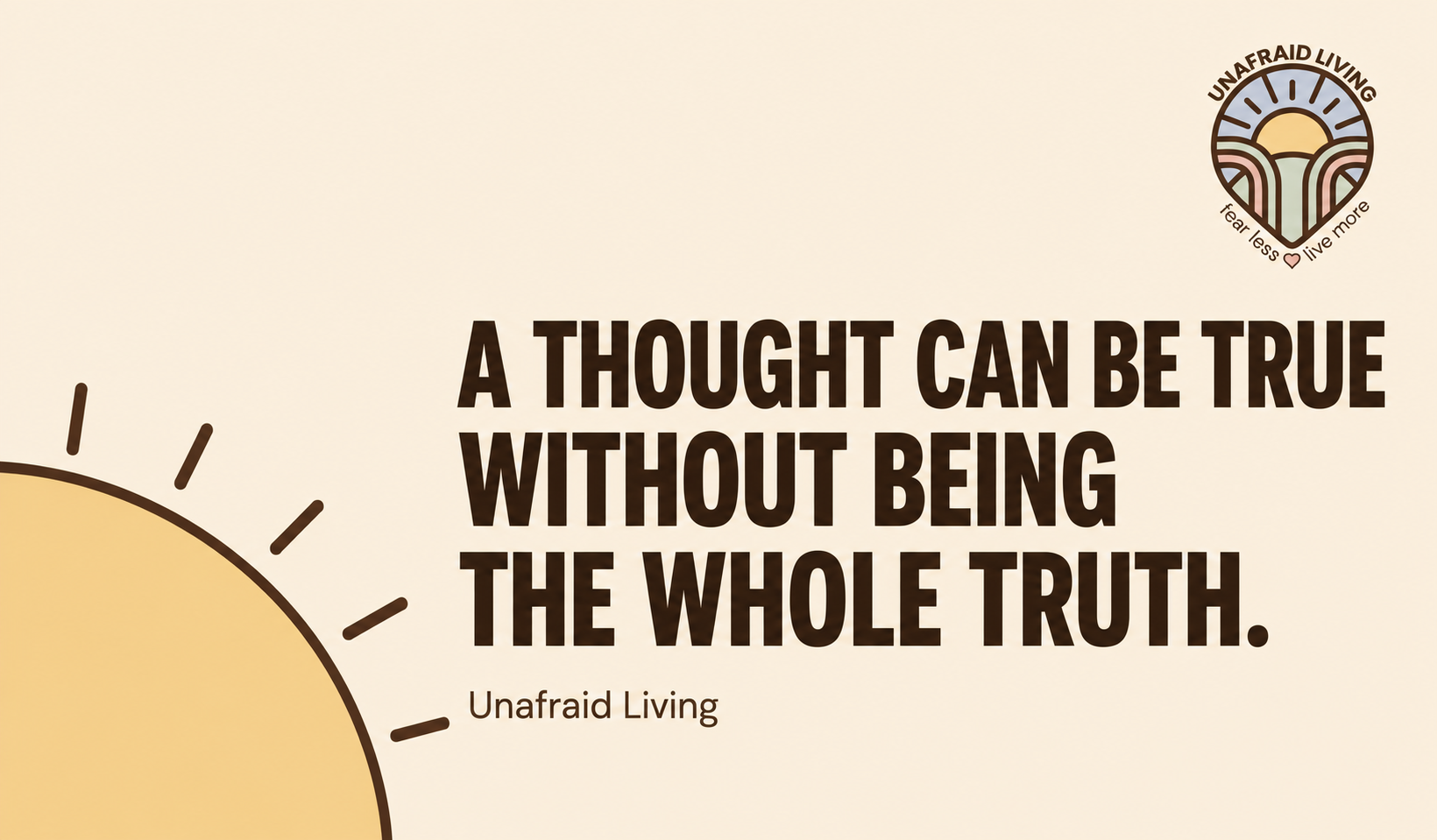
A Thought Can Be True Without Being the WHOLE Truth
When you are thinking, ‘there is no way out,’ it feels like reality. But the conclusion may not be the whole truth.
A distressed brain can present a conclusion with enormous certainty. That feeling of certainty can make it difficult to access logic, consider alternatives, or imagine that anything could change.
This is why telling someone to "have hope" or "think positive" is rarely helpful. If hope feels inaccessible right now, you do not have to manufacture it.
You can borrow someone else's perspective.
Borrow the perspective of the friend who knows this moment is not your whole story. Borrow the experience of the therapist or crisis counselor who has sat with people in unbearable moments and watched the picture change.
Borrow the practical support of a physician who specializes in mental health — they can help evaluate depression, anxiety, medications, medication side effects, sleep loss, pain, hormones, substance use, or other factors that may be affecting how you feel and think.
You do not have to believe everything will be fine. You only need to leave room for the possibility that your current view is incomplete.
What to Do When You Cannot Imagine a Way Forward
Do not make your next step depend on feeling hopeful first. Make it small and concrete.
The following 5 action steps are adapted from the evidence-based crisis response framework developed by mental health specialists at the National Institute of Mental Health (NIMH) and the 988 Suicide & Crisis Lifeline:
Tell someone plainly: "I cannot see a way through this, and I need you to stay with me."
Create distance from anything you could use to hurt yourself. Ask someone else to secure it or leave the environment.
Call or text 988 in the United States, or use the chat at 988lifeline.org.
If you are in immediate danger, call 911 or go to the nearest emergency department.
Let the next decision be about safety—not about solving your entire life tonight.
These steps are not a treatment plan. They are a bridge from a narrowed, dangerous moment toward more support and more options.
The Goal Is Not to Win an Argument With Your Brain
The goal is to create enough safety and connection for more of the picture to become visible.
What feels permanent today may be a circumstance that changes, a problem with more than one possible response, a condition that can be treated, or pain that becomes more bearable when it is shared and supported.
You do not have to know which one it is before you ask for help.
Please do not let the darkest moment make a permanent decision by itself.
If you need help now
In the United States, call or text 988, or chat at 988lifeline.org. The 988 Suicide & Crisis Lifeline is available 24/7. If you or someone else is in immediate danger, call 911 or go to the nearest emergency department.
Frequently Asked Questions
Is my brain lying to me when I feel hopeless?
"Lying" is too simple. Your pain may be real and your circumstances may be genuinely difficult.
The concern is that intense distress can narrow attention and make alternatives harder to imagine. Treat hopelessness as a reason to bring in support, not as proof that no options exist.
What is cognitive flexibility?
Cognitive flexibility is the ability to look at other possibilities, shift perspective, and consider different ways of responding. It can also include the ability to adjust to new information,
Why does talking to someone help?
Another person can provide connection, help you slow down an urgent decision, notice options you cannot currently see, and connect you with qualified care.
Social support and connectedness are also recognized protective factors in suicide prevention.
What if I do not want to worry anyone?
Letting someone know gives them the opportunity to help.
You can begin with: "I do not need you to fix this, but I need you to know I am not safe alone with my thoughts."
If telling someone close to you feels impossible, contact 988.
If Someone You Love Is Struggling
If someone tells you they feel hopeless or are having thoughts of suicide, do not rush to convince them that their thinking is wrong. Begin by letting them know you hear the pain underneath what they are saying.
You might say:
"That sounds unbearable. I am glad you told me."
"Are you thinking about suicide?"
"Do you have a plan or access to something you could use to hurt yourself?"
"I am going to stay with you while we get more help."
Be direct, calm, and present. Contact 988 together for help deciding what to do next. If the danger is immediate—or a weapon is involved—call 911. Do not put yourself in danger by trying to physically intervene.
Do not leave the person alone if you believe they may act on their thoughts.
This article is educational and is not a substitute for medical or mental health care. Suzette Parker is not a licensed therapist or physician. As a Brain Health Professional she helps people stay mentally fit. If you are in crisis, contact 988 or go to your nearest emergency department.
Sources
National Institute of Mental Health: Warning Signs of Suicide; Frequently Asked Questions About Suicide; 5 Action Steps for Helping Someone in Emotional Pain.
988 Suicide & Crisis Lifeline: Help Yourself; Help Someone Else; What to Expect.
Centers for Disease Control and Prevention: Risk and Protective Factors for Suicide; A Public Health Approach to Suicide Prevention.
Shields GS, Sazma MA, Yonelinas AP. "The Effects of Acute Stress on Core Executive Functions: A Meta-Analysis and Comparison with Cortisol."Neuroscience & Biobehavioral Reviews. 2016;68:651–668.