Is there a job you're qualified for, a conversation you've been meaning to have, a decision that keeps getting moved to "later" because you need more time to think it through?
If you tend to overthink things, taking risks doesn’t come naturally. You think until you’re sure. Your logical brain knows that you’re wrong sometimes, but that doesn’t matter. You want to feel sure, and so you think, and think some more, until you have a sense of certainty.
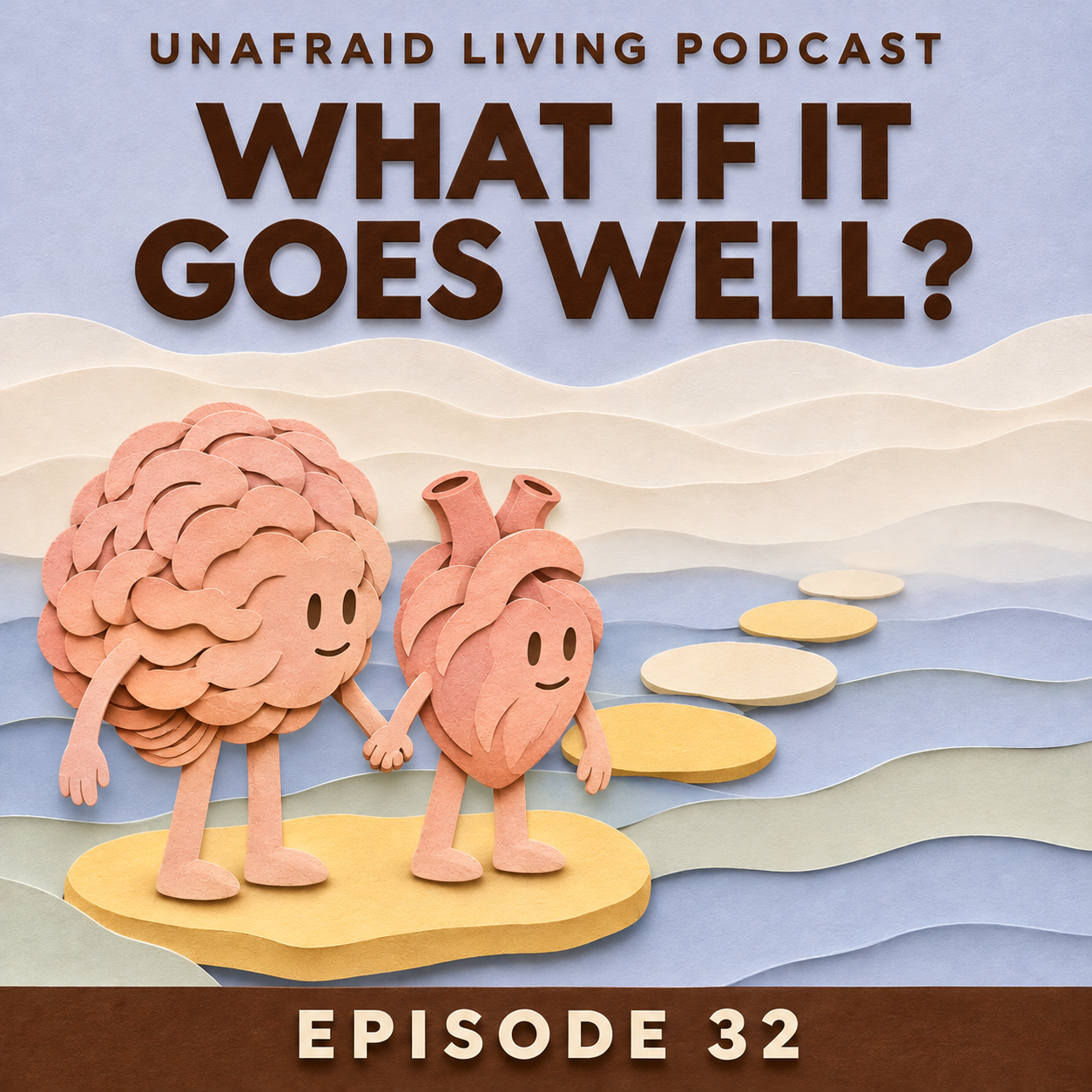
In Episode 32 of the Unafraid Living podcast, Kim and I talked about faith. Everyone has some type of faith. Here we are talking about faith as a way of living with what you don't know yet. You do your part, and then you rest — without knowing the ending.
This is the third episode in our Deep Thinker Series. If you took The Hidden Fear Profile Quiz and came out a Deep Thinker, this one is for you, though most of us will see ourselves in it.
Want to skip straight to what to do? Jump to Your Practice.
When Is Overthinking Actually a Strength?
I want to start with what's great about deep thinkers, because there's a lot. They see what other people miss, because they're noticing. They consider the consequences. They think through the different scenarios and the different endings, so they rarely show up anywhere unprepared.
People count on that. My husband can be an overthinker, and some days, I am so grateful for that character trait. For him, it shows up in some areas of life more than others. When we go on vacation, he knows which flights have the best seats, whether it's better to hire a driver, rent a Turo, or take an Uber, and where to stay for safety and convenience. He even plans an itinerary that balances my need for slowing down with his need for adventure. I can just follow along, which is wonderful for me.
On the other hand, when we needed to buy an SUV and it took him 18 months and hours upon hours of research on the internet every evening, it was quite annoying. The family still jokes about that, and it was a very long time ago. But he found us just the right one—snow-worthy, seven seats so our kids could take friends skiing with us, and a great safety record.
Preparing is wise. The trouble comes when we believe that if we prepare enough, we'll know the outcome. We hold on to all that preparation as if it could close the gap, and it can't. There will always be something we can't see.
Is Overthinking Holding You Back?
You know you should make that doctor's appointment, but what if they find something wrong? You start researching your symptoms, imagining what the tests might reveal, and convincing yourself you need to know more before you go. So you put it off.
Or there's a job you'd love, and you're qualified for it. But you can already see the interview going badly, not liking the team, or how you'll feel when you don't get it. So you say, "I'll think about it."
To a deep thinker, all of that looks like caution. Often, though, it's the negativity bias we all have taking over. When you're caught in a cycle of overthinking, your thoughts can drift toward the worst, and then it makes sense to back off. Why engage if it might go badly?
What's Happening in Your Brain?
Several things are happening in your brain when uncertainty makes it difficult to move forward. Let's start with two of them.
First, your brain wants to predict. It builds predictions from what has happened before, sometimes from a lot of experience and sometimes from one time somebody said something and it stuck. With all that experience deep thinkers might get good at predicting. But when a prediction fails, even once, it can feel risky to trust the next one.
Second, uncertainty leaves a loop open, and your brain keeps working on it. Those open loops keep pulling at you. (I told a story in an earlier episode about an open loop from my childhood and how many years it took to close. Ridiculous, right?)
Psychologists describe worry as a kind of attempted problem solving. Thinking things through helps when there's something you can actually solve. But sometimes there isn't, and your brain keeps working on it anyway.
Researchers call the discomfort of not knowing "intolerance of uncertainty," and for many overthinkers it's strong.
Why Does Backing Away Feel So Good?
This is the third piece, and I think it's the one that surprises people most.
When you back away from a risk, your anxiety drops. Your brain notices that drop, and the relief becomes a reward. It's called negative reinforcement: something uncomfortable goes away, and the behavior that made it go away becomes more likely next time. Do that often enough and backing away starts to feel normal.
That's one reason staying put can feel so safe. Same house, same neighborhood, same job, even a relationship that isn't great, because it's familiar and you know what to expect.
Over time it becomes automatic. A lot of risk-averse people don't think of themselves as risk averse. (Their friends probably do.)
Here's the part I find so interesting. Deep thinkers really don't like regret, so they avoid things that might cause it. But not taking the job in another city is a regret too.
People who avoid risks may eventually look back, see they missed opportunities, and feel some regret.
Is Feeling in Control the Same as Having Control?
If stepping back lowers your stress, why not keep doing it and keep that sense of control?
What stepping back gives you is a sense of control. It feels safer not to engage, not to take the risk, not to move forward. But is that really what you want in the long run? Those missed opportunities may suggest otherwise.
People who feel they have some influence over how things turn out tend to handle stress better. And the people who step out in faith, who actually do the thing, often have more influence over their lives than someone who never steps out at all.
That brings me to the fourth piece: when you feel responsible for how everything turns out, rather than just what you do, every risk can seem bigger. Choosing your next step, toward something you want deep down, tends to lower stress. "I'm responsible for how this turns out" is a heavy load, and it was never fully yours to carry.
What Does Faith Have to Do With It?
This is where faith comes in. Faith helps you recognize what you can control and what you can't. It doesn't mean sitting around waiting for something to happen. You take the next step and do your part. And you accept that you can't know how everything will turn out.
If accepting uncertainty, trusting, or taking reasonable risks is difficult for you, exploring the spiritual side of your life may be worthwhile. The four circles of brain health are Biological, Psychological, Social and Spiritual. Exploring your spiritual life and questioning your belief system can be a healthy part of growing into the confident person you want to be. Research on spiritual practices like prayer and meditation suggests they can help people cope with the uncertain things in life.
If you don't have religious faith, you can still explore what gives your life meaning, what you believe, and what helps you find peace when you don't have all the answers.
Can You Stop Overthinking and Move Forward?
Telling yourself to stop worrying doesn't work. But changing the questions you ask yourself can help. In the podcast, Kim explains how she approaches uncertainty: she acknowledges that something could go wrong, but reminds herself that it probably won't be as bad as she imagines.
All day long we ask ourselves questions, and a deep thinker's default is usually "What if it goes wrong?"
Try this one instead: "What's the best thing that could happen?" And if you're still worried, ask yourself, "How will I handle it if it doesn’t work out?" Chances are, you've already handled plenty of disappointments in your life.
In my experience coaching, changing the question is one of the most helpful things an overthinker can do. What you keep focusing on tends to get more of your attention, and it shapes how the next step looks.
This can be especially helpful at 2 or 3 in the morning, when the looping tends to happen. The question you hand your brain can shape where it goes, and some people wake up with a better outlook.
And if a thought shows up in the middle of the night, write it down, or give yourself an appointment: "I'll think about this tomorrow at 10, for 15 minutes." Deep thinkers can let their lives get overrun by thinking. A time block helps you stop ruminating and actually solve the problem. Ruminating does not solve problems, but thinking can.
What If You Can’t Stop Thinking About It?
Here's another question that helps: "Do I have any new information?" If you don't, leave that subject on the shelf until you do.
I know that can sound like "just stop thinking about it." What it really means is to stop circling without the information you need. If you can find that information, go get it. Otherwise, put the subject aside until there's something new to consider.
The thought may come back, perhaps several times. That doesn't mean you failed. It's how your brain learns that you have a new routine for this thought. It popped off the shelf for a second, so you pop it back up.
You'll have to do it several times before your brain learns the routine. Each small step where nothing terrible happens gives your brain new information: "I'm okay when I don't overthink." That gives a prediction machine something new to predict with. The worry may not disappear, but with practice, it may become easier to let it go.
Your Practice
Pick one thing you keep thinking about and putting off. Then try the Next Step Test. You only need to take one small step.
The step is one of two things:
Put it on the calendar. Give yourself a set block of time to think it through. Fifteen minutes is often enough. If it's something big, maybe an hour. More than that in one chunk is probably too much.
Go get the information you need. If you're missing information that would help you decide, take one step toward finding it.
Stepping away and coming back also gives your brain time to put things together in the background, and you'll probably do your other work better too.
Download the free printable practice worksheet — one page, no email required: THE NEXT STEP TEST Practice
Can a Deep Thinker Still Be a Mover and Shaker?
Absolutely. Plenty of very successful people are deep thinkers. They learned how to stop ruminating, put things on the shelf and go find the information they need. Nobody is asking you to think less. Keep thinking deeply. It's a gift. Take the circling out of it, and take the next step even when you can't see the ending.
Ready to Go Deeper?
Not sure where to start? Take the free 3-minute quiz. It shows you the pattern behind what you keep putting off, so you know which tools to practice first.
When you're ready for more, the UNAFRAID course walks you through the tools step by step. Start with the first two modules for $37, or take the full course for $197, at unafraidcourse.com.
Explore the Deep Thinker Series:
🔗 Episode 30: Why Overthinking Feels Like Getting Closer to an Answer (The Brain Science of the Deep Thinker)
🔗 Episode 31: Why Your Mind Keeps Wandering (And What Mindfulness Really Does for a Deep Thinker)
Coming next: Playfullness!
Frequently Asked Questions
Why do overthinkers struggle with uncertainty?
Your brain likes to predict, and when it can't know how something will turn out, the question stays open and it keeps working on it. Researchers call the uncomfortable feeling of not knowing "intolerance of uncertainty." For many overthinkers it's strong, so the thinking goes in circles trying to fill in a gap that thinking can't close.
How do you take a chance when you don't know how it will turn out?
Change the question you ask yourself. Instead of "What if it goes wrong?" ask "What's the best thing that could happen?" and "If it works out, will I be able to handle it?" Then take one small step: put the decision on your calendar with a set block of time, or go get the information you need. In my experience coaching, that one step does more than another hour of thinking.
What does faith have to do with overthinking?
Faith is taking the next step without needing to know how things will turn out. It draws a line between what's yours to do and what was never yours to control. For people of religious faith, that can mean putting the outcome in God's hands. For people without it, finding support beyond yourself can help in a similar way.
How do I stop ruminating at night?
Write the thought down, or give it an appointment, such as 15 minutes tomorrow morning. Ask yourself, "Do I have any new information?" If you don't, put it on the shelf until you do. When the thought comes back, put it back on the shelf. With repetition, your brain learns the new routine and the worry tends to loosen its grip sooner.